
Book Review: SOS Help for Emotions by Lynn Clark

Book Review: SOS Help for Emotions by Lynn Clark

“SOS Help for Emotions” follows the Rational Emotive Behavior Therapy (REBT).  This is a well-written tool for dealing with emotions from man’s perspective.  It was suggested that I read this to help me understand how people struggle with their emotions and several tools for dealing with them.  Clark is obviously well-educated, very astute in the realm of observing how people make decisions and creative in teaching a humanistic approach to dealing with emotions. He is engaging and creative.  However, as stated, it is man’s approach and not God’s approach.  “SOS” is the Morse Code for help, and I get that for the title of the book, yet I would politely says that SOS stands for “Self-Oriented-Solutions.”
It’s obvious that Clark has extensive professional experience in community centers, hospitals and counseling agencies.  I’m very confident that Clark is very successful in counseling, because the observations and solutions “make sense.”  The observations are truly what a person would see as people make decisions.  The solutions are tangible ways to make decisions if there were no God and no Scripture that tells us how we are to make decisions.  The closest Clark comes to identifying any solution to a Bible-based solution is St. Francis’ Serenity Prayer. 
He gives hope, but not from Scripture, therefore the hope can only be temporary according to a person’s own strength to make decisions.  He never mentions the good news of the Gospel, any Scripture, the reality of sin, or any reliance upon what God has provided regarding solutions.
He establishes from the beginning that the foundation for SOS is rational emotive behavior therapy (REBT) (4).  “Feeling safe” is one of his intended solutions (8), rather than being safe in Jesus (Col. 3:1).  He identifies “Anxiety, anger, depression and contentment and happiness” as core emotions and those are predominant aspects of thinking (9), but his solutions are not according to Scripture. He truly states that “unbridled emotions can also…spike our blood pressure, causing a blood vessel to burst leading to a stroke,” which is true (9).  The challenge is that someone who is not well-grounded in Scripture may not discern truth from error.  He states, “Motivating ourselves to achieve our goals, of course is dependent on knowing and managing our emotions,” (14) which has truth in that we must be aware of our emotions, but the motivation is to please God (2 Cor. 5:9) and managing our emotions comes by putting on biblical thinking through renewing the mind (Eph. 4:22-24).
Clark provides excellent observations about how humans think.  For example, he states, “Various physical conditions (illness, lack of sleep, poor nutrition) can predispose you to be easily upset” (16) and “Our emotions are largely, but not entirely, controlled by our beliefs, the way we think about problems, and our silent self-talk.” (17) These are both true.  He observes, “Emotional stress can cause increased muscle tension…” and “Emotional stress can stimulate the stomach to secrete too much acid which can lead to heartburn and gastritis,” (18) which are both true.  The challenge is, how does the average reader know when Clark is making true observations and when he is making suggestions that are humanistic and not biblical? 
I appreciate his comment quoting Epicticus, “People are disturbed not by things, but by the views which they take of them,” (24) which has great truth in it, because how we respond to situations is the issue, not the situation.  And his principle, “The one thing psychologists can count on is that their clients will talk to themselves and not infrequently, whether relevant or irrelevant, the things people say to themselves determine the rest of the things they do” (27) has truth.  Even Scripture says as we think, so we become (Pro. 23:7) and we DO need to renew our thinking if we are going to be transformed (Rom. 12:2).  However, we must conform our thinking according to Scripture (2 Tim. 3:16-17), not what seems to make sense or what is expedient.
His charts are helpful to understand his therapy solutions.  “Crooked thinking” that doesn’t include “beliefs and self-talk” certainly will not help people understand why consequences result (29).  His directions to take responsibility rather than blaming (30) is a biblical  approach, but he gives no biblical basis and doesn’t identify any thinking or actions as sin.  A major problem is that he never identifies any solution with the need to be dependent on God, but just develop better “self-talk” (33) and you’ll gain control.
There is truth to some of his analysis of how we get into misery.  We do flip on the “I must, you must or the world must” attitude and then we link those statements to “’condemnation, ‘awfulizing,’ ‘I-can’t-stand-it-itus,’  ‘I’m worthless,’ and ‘always and never’” resulting in bad thinking of anxiety, anger and depression” (40) and those things do happen.  Those kinds of comments engage a person, because the person will say, “That makes sense” or “That’s what I do.”  The challenge is a person may try the suggested solutions, which exclude God’s power, and the person may get temporary relief, but not renewed thinking or a holy lifestyle.
He never identifies any thought or action as sin. He explains and gives great illustrative examples of sin (48, 53, 83), but without identifying the problem as sin, there will be no spiritual solution to unleash God’s delivering power.  He does call problem areas “irrational beliefs and self-talk” (87), but that still places the standard on self, rather than on God (2 Tim. 2:15).
One of his solutions suggested will be different with every person.  For example he states, “Replace Musts and Should with Preferences and Wishes,”(72) so that establishes the person as the standard rather than the unchangeable nature of God and His Word (Heb. 13:8).
This book is like many self-help books; they are about self and how self can help.  Instead of finding strength in self, the Christian ought to find his strength in Jesus Christ (Phil. 4:13).  Too many Christians will read pop books on self-help and because the observations and suggestions seem to make sense, they try them.  The enemy is waiting for this and wants them to buy into the system and live by the humanistic solutions.  That just creates frustrated Christians, who do not tap into the power of God for real transformation (Eph. 1:18-19).  As nice of a person as Dr. Clark is, as much as he wants to help people, as sincere as he is in believing he has solutions through REBT, he will only lead people further away from God and God’s solutions.  At best his solutions are tainted light rather than the pure milk of God’s Word.  Unless you have years of biblical study to discern truth from error, do not open yourself up to these humanistic suggestions.  I’m sure I still miss many.
Book Review: Fail-Safe Investing by Harry Browne

Book Review: Fail-Safe Investing   by Harry Browne

“Fail-Safe Investing” by Harry Brown is a quick read that exposes the fallacy of expert professionals in the economic realm.  Browne wisely delineates 17 rules for investing and simply explains his analysis of why those principles will keep the average investor out of trouble.  His thesis seems to be “Be wise about investing in four general areas for your permanent portfolio and don’t assume expert advice will capture your dreams.”

Your portfolio, which is a collection of investments you hold, should be governed by three principles of 1) safety – guarding against every possible economic future; 2) stability – regardless of the economic climate you’ll not have to change the portfolio; and 3) simplicity – that is a portfolio that is easy to maintain and requires very little time to manage.

His “17 Simple Rules of Financial Safety” are clear, simple and easy to understand.  He debunks the expert myths by exposing some of their expertise. For example, when an expertise makes claims to his foretelling of future events, the original claim is often very unclear what he was actually predicting.  Often in the days preceding and succeeding the supposed prediction, he was also making other statements that demonstrated the market could have gone in another direction.  A second example is when the expert highlights the predicted trends over a period of years, like from 1980 to 1987, and he emphasizes the huge returns an investor would have enjoyed if he had followed the expert’s advice.  Yet if an investor had chosen 1987 to begin following the expert, he would have lost significantly in the crash of October, 1987.  Additionally certain years are chosen to maximize the profit achieved. A third example is when claims are based on past events.  No expert has been successful predicting the future of the market, or that expert would have been a billionaire many times over and owned his own country.  Browne’s considerate and non-inflammatory exposure provides a realistic way to look at investing.

While Browne does not highlight Scripture, he does address “get rich quick” approaches to investing and the foolishness of it.  He exhorts in his first principle to “Build your wealth upon your career,” rather than trying to gain wealth by speculating.  Speculating is okay as long as it doesn’t interfere with the four fold plan he outlines and it is money that can be lost.  He wisely discourages borrowing for investment and taking from the “permanent portfolio” to support additional speculative investments. 

I find many of his quips to be very humorous.  For example, “The investment expert with the perfect record up to now will lose his touch as soon as you start acting on his advice,” and “The system that has worked perfectly up to now will go sour when you stake your money on it.”  The humor is that I have seen those as true.

Harry Browne is a well known investment advisor for over forty years.  He was a Libertarian candidate for president in 2000.  This is an excellent read.

Book Review: Who Moved the Goalpost? By Bob Gresh

Book Review: Who Moved the Goalpost?   By Bob Gresh

The best part of being a human being is experiencing all the sensory experiences God has created.  The worst part of being a human being is experiencing all the sensory experiences God has created.  The difference is known by God’s truth and discernment of wisdom.

There are many books highlighting the challenges of being godly in a temptation-filled world of lust.  Bob Gresh has put together a great set of winning strategies for men, especially men in the younger years.  The world has seized the hearts of young men down to ten and eleven years old and tantalized them with the blatant imagery, false promises and empty experiences of pornography.

Bob exposes Satan’s three sex lies that set young men up for a world of frustration, misery and pain.  Sex is not a four-letter word, you are not here alone and it (lust) won’t go away when you get married.  But men believe those lies and fail to enjoy the sex that God designed to be enjoyed between one man and one woman in marriage.

Bob then describes three truths that can give a young man hope if he waits on the Lord for the right person.  God’s way is so much more fulfilling than anything the world has to offer.  The flesh doesn’t want to wait or be restricted, but the reward is spectacular.

Bob finally lays out seven strategies for success on preparing for a lifetime of enjoyment in marriage and how to finish strong.  Guys, we need to teach young men in Middle School and High School these principles.  Moms, if you have boys and you are parenting alone, then you’ll have to grab hold of this and help prepare your boys. 

Parents, your boys are going to learn about sex and you don’t want them to learn on their own or from the world.  Too many marriages are struggling and are being destroyed, because young men have not been taught God’s view for biblical sex.  The enemy is destroying too many lives by his quick fix solutions.  God’s way is always best.  Bob Gresh presents this serious material in a well constructed way and includes good-young-men-humor along the way.  You can help young men not miss out on what so many men are not able to enjoy, because they didn’t learn God’s way of enjoying sex.

Book Review: God versus Socialism by Joel McDurmon

“God versus Socialism: A Biblical Critique of the New Social Gospel” by Joel McDurmon. This book will make you humanly mad and divinely wise.  We in America for too many years have fallen under the pretense that “America, right or wrong, America.”  The problem is that we are swiftly floating down the river of socialism in the name of doing good.  We Americans have bought the premise too many times that Scripture deals with spiritual issues and not other mundane concerns like politics, property and population.  We have begun to look to the king (government) for the answers, rather than trust the King of Kings and obey what His Word already says.

Joel McDurmon in his excellent volume “God versus Socialism” has done a brilliant job of exposing the evil promulgated by government programs intended to help the masses.  However, by helping the masses, the government messiah has stolen from the rich to enable the poor to continue in poverty.  There is only one King and He owns everything (Ps. 24:1).  The foolishness of man has been and is to look to man for answers which he will never resolve in the realm of mankind, Republican, Democrat or Independent.  Conservatives, especially the NeoCons of the last two decades are no better than their Liberal counterparts.  They have increased the size of government in the name of personal power and individual aggrandizement.

McDurmon astutely exposes the evil agenda of several contemporary authors and speakers.  At best they believe what they are writing will help, at worst, they are deceived by seducing spirits.  McDurmon uses the subtle, or not so subtle, agenda of Jim Wallis, Tony Campolo and Ronald Sider as examples of wolves in sheep’s clothing.  They have infiltrated many denominations and pulled them perilously close to the cliff, pushing many off into the chasms of ineptness and spiritual despair.  They have twisted and distorted Scripture for their own purposes, which in short is to strengthen man’s dependence on man’s government, to redistribute property and to dislodge the Christian’s understanding of biblical theology.

Christian Socialism is an oxymoron, because instead of freedom in Christ, Christians are set into bondage to the state.  Unfortunately too many Christians like the benefits they seem to get on their personal behalf and they don’t have to see who the government is stealing from in order to pay for what they need.  It’s simply another ploy from the demonic realm that Christians will one day find themselves in such a deep pit of dependence on government and not be able to extract themselves from that pit.  “The biblical view provides for freedom and responsibility, the socialist view leads to serfdom, slavery to government, and dependence on the state.” (p. 223)

Book Review: Raising Chickens for Dummies by Kimberly Willis and Rob Ludlow.

Raising Chickens for Dummies  by Kimberly Willis and Rob Ludlow.  Why am I reading a book on chickens?  If you’re following my Book Reviews, you caught that I just read a great book on raising goats, and chickens and rabbits are the other two animals I’d like to add to my “family” someday.  I’d love to teach my grandchildren about animal husbandry, but I’ve got to understand it first! 

It’s certainly not something someone from the city can wish to do one day and actually do it the next.  There is an incredible amount of information to learn and experience to gain.  I’m not there in either category, but I’d love to learn and gain, while I shepherd people. 

“Raising Chickens for Dummies” is no quick read.  In other words, it isn’t 35 pages and you are supposed to know everything.  It’s 370 pages of good information, without much white space or pictures.  It’s well written and covers the gamut of chickens, but I’d be concerned that after a week of experience, I’d need to spend time re-reading this book in the pertinent areas.  It’s an impressive organization of instruction, advice and warnings from choosing what kinds of chickens you might want from the type of housing and finally the management of handling “Layers” and “Meat Birds.” 

I’ll leave this review very short, because it’s so different from most of the books I read, but off this quick note so that you might consider broadening your horizon of what you read and even consider one day you might want a few chickens for yourself (if your housing codes and covenants allow them).  I do wish the book had more pictures on the suggested structures to be built and handling of the chickens.  There is repetition in explanations, but it is helpful for those who pick and choose what portions of the book are needed.  The authors have done a nice work in repeating what needs to be repeated to ensure you won’t miss something important if you only read chapters 7, 9 or 12 by themselves.  Check out www.backyardchickens.com for more information on raising chickens.

Book Review: Your Goats: A Kid’s Guide to Raising the Showing by Gail Damerow

Your Goats: A Kid’s Guide to Raising and Showing by Gail Damerow is a great starter book on Hobby Farm investigation.  Okay, okay, I admit this is a strange book for me to do a review on, but in my interest for having a Hobby Farm, I’m trying to read a few books related to it.  I went down to my uncle’s farm for a week at a time each summer, but I never grew up on the farm.  I always enjoyed the life, but doing anything for a week, does not equate with expertise or experience.  Hence, I better read before I think I can join Green Acres.

This is a great book discussing goat husbandry at a teen level.  It is right where I am and I needed something simple to get me started.  I had a blast reading about how to think like a goat, what kind of housing I would need to provide, breeding goats, milking them, raising them for meat and making them a part of the overall family plan for future generations. 

There are better books with more detail, other books with better pictures, but this is just right to spark my interest to press for more information if God were to allow some husbandry in the future.  Goats, chickens and rabbits will never take the enjoyment I get from ministering with people, but if it works out in the future, I’m ready to try my overalls again.

Book Review: Hurt 2.0 by Chap Clark.

Hurt 2.0  by Chap Clark.  I was drawn to this, because I like young people.  I wanted to understand them.  I no longer am young and they will be the avenue for the future, so it’s important for me and others to understand in order to disciple.  I was hoping for more theology; this is definitely a sociological study.  It’s still worth the read.  While he doesn’t teach the theology of youth, he does present who the youth are today and suggests what should be done.  A wise Christian will take his word and enter into the youth world in order to transmit the gospel for God to transform the youth culture.  To avoid it is foolishness and an abandonment of godly principles.

When I first started reading, I was put off.  It was far more detail than what I was interested in. However, I realized, Chap Clark is making observations and they seem true.  He’s spent the time that I do not have to find transparent youth who mirror their generation.  Chap Clark engaged the youth culture, done an incredible amount of research and then assembled that research into helpful portions that address landscape of the youth rising up to maturity.  Who are they?  What do they want? And what is their world like?

When I was a youth in the 60s, my world was totally different than today.  We did not have cell phones, emails, DVDs or game boxes.  The isolation, family abandonment and individualism of society of today wreaks havoc on the stability for youth.  Divorce, drugs, immorality and perversion is far more rampant today than 40 years ago.  Consequently, the youth have far more to deal with and need a more available ear.  Chap writes about the changes in adolescence jargon (a term I really don’t like, but have to accept), the whole notion of abandonment and how it develops.  The dark world the teen adolescent lives in is far more confusing than my relatively simple world.

There are many things that are the same, but Chap says they’re different.  Peers, school, family, sports, sex and ethics are some of the things that have changed.  For example, today students “believe that “teachers do not even deserve the benefit of the doubt and that, instead, teachers must earn the respect of students by showing them respect first.” (p. 83)  Did the emphasis on self-esteem over the last thirty years produce this perverted thinking?  Regarding family, “The academic and popular debates adults have wages over the definition, meaning and impact of the family have taken a toll on the young.  What has happened with the notion of and attitude toward the family is perhaps the most significant form of cultural abandonment midadolescents have endured.” (p. 93)  So much that “…those who had learned (or were learning) to use their bodies to find comfort and connection through sexual play were trying to prove to themselves and to the world that they were worthy of love.”  Remove God from a person’s life and of course all they go by is their senses and especially their feelings.  He goes on to cite an article from the American Psychological Association, “…there is no longer a standard definition of family. It simply means what one wants it to mean: ‘Families today can take many forms-single parent, shared custody, adoptive, blended, foster, traditional dual parent, to name a few.’” (p. 94)  And in the downward spiral of America it will take on different degenerate meanings.

The attitude toward the sanctity of sex in marriage continues to evolve.  One student commented, “’Sex is a game and a toy, nothing more.’ As I was to find out, it is actually more than that- it is a temporary salve for the pain and loneliness resulting from abandonment.”  (p. 116)  Additionally, Clark writes, “There is a genuine belief in the midadolescent world that sex with a relative stranger can be the route to happiness and fulfillment.” (p. 127)  That is a quick way to build callousness on the soul and heart toward godly things.

The attitude toward ethics is spiraling down.  Clark notes, “…researchers found that high school students were far more carefree and casual about cheating than were high school students were far more carefree and casual about cheating than were college students…[because they] do not seem to give much energy to ethical issues that do not provide immediate self-promotion or protection.” (p. 148)  So what kinds of decisions will they make when they are confronted by real tough decisions regarding crises in their lives?  I’m not sure they’ll be thinking of others as more important than themselves.

A key take away from the book is “…the three basic issues of the adolescent journey are identity, autonomy, and belonging.”  (p. 168)  The question is who is helping reach them so they can identify with Jesus Christ, see their interdependence in the body of Christ and belonging to the family of God.   Clark does not teach the theology of helping adolescents, but he does emphasize youth need 1) refocused, nurturing organizations and programs, 2) stable and secure loving presence, and 3) to experience authentic, intimate relationships with adults. (p. 191-192).

I found the book valuable for what it observes regarding youth.  It was helpful in broad sweeps of exhortation to spend time with youth, but it doesn’t direct youth or leaders to draw upon the resources of the Lord Jesus Christ from Scripture.  It is a sociological book, not a philosophy of ministry based on Scripture.  With that understanding, a good understanding of youth can be gained and hence make a leader much more wise in relating to youth.  Who will stand in the gap and pick up the mantle to be available to them?

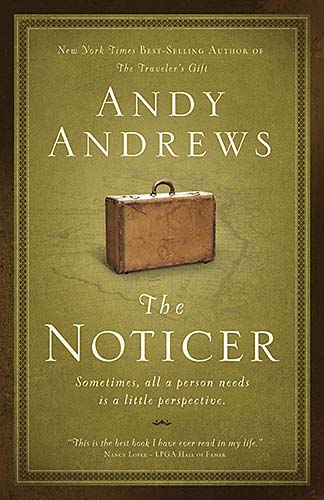
Book Review: The Noticer by Andy Andrews

This book has a great impact on many people. It’s a simple book with thought provoking conversations between a wise older man, “Jones,” and several characters he influences on their journey in life. It is a common sense book and a very enjoyable read, but it leaves out divine reality and truth.

The main character, Jones, is a drifter sort of man who meets individuals in poverty, a failing marriage, old age, failing business and other hopeless situations. Jones helps them see a new perspective to enable them to move forward out of their dire circumstances. Jones offers simple wisdom and hope. For example, in the failing marriage episode, he shares four love languages, which mirror the five love languages that Gary Smalley teaches (Jones doesn’t mention gift giving as a fifth love language). The struggling husband accepts Jones’ advice and returns to his marriage with a fresh perspective and new start. There were several other bits of advice that seem to have a spiritual background, but there is no reference to divine solutions.

One of the penetrating questions Jones’ poses to his listeners is, “What would other people like to change about you?” In other words, what change is necessary in the listener for others to enjoy being around him more? If I am other-centered, as Scripture declares I need to be, then I should consider, reflect and ask others what it might change, so that I can be more effective at building bridges and having a greater influence on others.

Another example is not using “if’s” or “but’s” when asking for forgiveness. For example, if I were to say, “If I hurt you, please forgive me.” That statement doesn’t acknowledge at all that the offender recognizes any offense. It’s really a statement that says, “Let’s get this over with so we can get on with life. You are just very sensitive.” It’s a biblical principle to avoid “if’s” and “but’s” in asking for forgiveness, but the author does not make that connection.

In the same account, Jones asks “Henry” about his unborn child and what name his wife wants to give him. Henry mentions “Caleb” and Jones mentions that the name Caleb is from a noble man who became a ‘victorious old man’ without referring to the biblical account of the story from Joshua 14.

The author, Andy Andrews, invites the reader into realistic conversations that give hope for life. Some of the drama is slow and often the advice very simple. While there are hints of spirituality, neither Jesus Christ nor the grace of God are included as beacons of hope or assurance that God is in control. I enjoyed this casual read as I was not looking for in-depth theology, apologetics, or deep answers to life’s questions.

Book Review: Porn Nation: Conquering America’s #1 Addiction

Porn Nation: Conquering America’s #1 Addiction by Michael Leahy

Michael Leahy was moving successfully through life, until someone with the same problem confronted him, even though he was not willing to admit the problem at first.  The cloud of sin had created such a calloused soul that he didn’t think he was affecting anyone else.  His double life was his double life, until the truth exposed his dark lie and his world came crashing down.

There is no question that Michael had a tough life growing up, although not greatly worse than many others.  His exposure to mild pornography as a young teen was the stimulus that created a desire for more.  The pornography that he fed grew to a huge gorilla in the room that he was not willing to admit until he was out of control and he destroyed his marriage and his relationship with his wonderful young boys.  This is a very sad story, but real enough that it will help many others who have fallen into (dove into) the bondage of pornography.

When Michael found porn on the internet, his valley became deeper than he could imagine and his callused soul was willing to do anything to keep feeding his desire.  This volume will help many who have succumbed to pornography, yet it doesn’t spend enough time giving biblical solutions.

He grew up in a Catholic home and it seems like he switched to another church, North Point Community Church and he references his pastor, Andy Stanley. I would have desired him to explain what he followed to break his life dominating sin, rather than just mention the 12 step program that he joined.  There was so much time spent on the sordid details of his life until the exposure of his sin and relatively little spent on a biblical solution.  I rejoice that he is in a growing marital relationship and that this volume will help many other men identify the potential crossing lines that get a man (or woman) into trouble.

Book Review: How do you kill 11 Million People? by

How do you kill 11 Million People? By Andy Andrews

This is a strange title, but an excellent book.  It’s a short read, but helpful for those who understand “normalcy bias.”  Normalcy bias is the principle that people move deeper into danger, because they do not realize how current events are becoming worse and worse.  It happened in the 1930s, when the Jews were mentally manipulated by Hitler’s regime to think “it won’t get any worse” and the government said, “We’re doing this for your protection.”  The “new normal” was merely another step to the destruction of the Jews by means of the death camps.  Some Jews fled Germany and Holland in the 30s, but those who did not were sent to camps.  The Normalcy Bias is thinking, “Things can’t get any worse from this state of being.”  Andy Andrews shows how Germany killed over 11 million people – Lie to them. It has happened in other regimes as it did in Germany. People believe the government.  They believe because they want it to be true.  They believe to their death.  People are sheep and will listen to the voice that tells them what they want to hear.  What should the United States learn from this?  Ask the question, “What is the truth?”  Truth is being removed from the United States everyday and yet we are still trusting the government.  Andrews does not write this, but the reason is because the truth – Jesus Christ – is forgotten in our world.  As He is removed from society, the sheeple (sheep – people) will believe what they want to hear.  Will we realize it before it’s too late?