Book Review: Sexual healing: A Biblical Guide to finding freedom from Sexual Sin and Brokenness by David Kyle Foster

Sexual healing: A Biblical Guide to finding freedom from Sexual Sin and Brokenness by David Kyle Foster. There has been a multitude of books on sexual addition, pornography and seeking purity in life. David Foster has added a significant dimension to the discussion in several areas.  His transparency of his own sexual addiction gives him credibility for writing on the subject and for following his suggestions on restoration to pursuing purity with Jesus Christ.  Yet his use of God’s Word is even more important and helpful to a man who wants the transforming power of God’s Spirit from spiritual misery to heavenly holiness.

He lays the Foundation in Part One where he addresses five helpful issues.  The “Foundations for Healing Sexual Brokenness” focuses solely on the Lord Jesus and the inability of anything a person can do on his own to help himself.   His character descriptions of God are helpful as a sexual addict seeks God’s power to be transformed.  Chapter two, “God, My Father,” doesn’t lay blame on earthly fathers, but explains God the Father’s design for how to relate to Him, because of how He relates to us.   It is clear, balanced and inviting.  Chapter three, “Living by Grace Rather Than Performance,” establishes that grace is not a license to sin, but a freedom to live by God’s grace, rather than by rules or performance. Excellent principles amplify the clarity of God’s grace in healing sexual addiction.  Chapter four, “The Divine Intent for Sexuality,” delineates God’s wholesome purposes for sex and how God completes individuals supernaturally.  And Chapter five, “Root sources for Improper Sexual Development,” develops a broad understanding of all the competing influences into a man’s life that can support him or pull him crashing down.

His Part Two examines specific sexual sin areas.  These are good chapters.  The two chapters on homosexuality became old, because the sin, while gaining a strong foothold in society also leaves an odious taste.  I confess I need to be patient and keep growing in understanding this aberrant behavior.  The chapter on the M word approached the selfishness of the act in a way that was very helpful.  Fortunately many writers expose the selfish sin of M, but Foster relates the vivid memory explosions that litter a man’s mind of one who dabbles and becomes addicted to the action.  He also explains well how it can dreadfully harm a marriage, but he gives great hope for the man who will pursue God’s way of freedom to holiness.

David Foster has added a significant dimension to the sexual addiction discussion.  Because of the insidious nature of pornography and sexual immorality, men (and women) need to be led into God’s word through helpful tools like this.  May God grant men freedom from this horrible epidemic.

Book Review: God versus Socialism by Joel McDurmon

“God versus Socialism: A Biblical Critique of the New Social Gospel” by Joel McDurmon. This book will make you humanly mad and divinely wise.  We in America for too many years have fallen under the pretense that “America, right or wrong, America.”  The problem is that we are swiftly floating down the river of socialism in the name of doing good.  We Americans have bought the premise too many times that Scripture deals with spiritual issues and not other mundane concerns like politics, property and population.  We have begun to look to the king (government) for the answers, rather than trust the King of Kings and obey what His Word already says.

Joel McDurmon in his excellent volume “God versus Socialism” has done a brilliant job of exposing the evil promulgated by government programs intended to help the masses.  However, by helping the masses, the government messiah has stolen from the rich to enable the poor to continue in poverty.  There is only one King and He owns everything (Ps. 24:1).  The foolishness of man has been and is to look to man for answers which he will never resolve in the realm of mankind, Republican, Democrat or Independent.  Conservatives, especially the NeoCons of the last two decades are no better than their Liberal counterparts.  They have increased the size of government in the name of personal power and individual aggrandizement.

McDurmon astutely exposes the evil agenda of several contemporary authors and speakers.  At best they believe what they are writing will help, at worst, they are deceived by seducing spirits.  McDurmon uses the subtle, or not so subtle, agenda of Jim Wallis, Tony Campolo and Ronald Sider as examples of wolves in sheep’s clothing.  They have infiltrated many denominations and pulled them perilously close to the cliff, pushing many off into the chasms of ineptness and spiritual despair.  They have twisted and distorted Scripture for their own purposes, which in short is to strengthen man’s dependence on man’s government, to redistribute property and to dislodge the Christian’s understanding of biblical theology.

Christian Socialism is an oxymoron, because instead of freedom in Christ, Christians are set into bondage to the state.  Unfortunately too many Christians like the benefits they seem to get on their personal behalf and they don’t have to see who the government is stealing from in order to pay for what they need.  It’s simply another ploy from the demonic realm that Christians will one day find themselves in such a deep pit of dependence on government and not be able to extract themselves from that pit.  “The biblical view provides for freedom and responsibility, the socialist view leads to serfdom, slavery to government, and dependence on the state.” (p. 223)

Book Review: Raising Chickens for Dummies by Kimberly Willis and Rob Ludlow.

Raising Chickens for Dummies  by Kimberly Willis and Rob Ludlow.  Why am I reading a book on chickens?  If you’re following my Book Reviews, you caught that I just read a great book on raising goats, and chickens and rabbits are the other two animals I’d like to add to my “family” someday.  I’d love to teach my grandchildren about animal husbandry, but I’ve got to understand it first! 

It’s certainly not something someone from the city can wish to do one day and actually do it the next.  There is an incredible amount of information to learn and experience to gain.  I’m not there in either category, but I’d love to learn and gain, while I shepherd people. 

“Raising Chickens for Dummies” is no quick read.  In other words, it isn’t 35 pages and you are supposed to know everything.  It’s 370 pages of good information, without much white space or pictures.  It’s well written and covers the gamut of chickens, but I’d be concerned that after a week of experience, I’d need to spend time re-reading this book in the pertinent areas.  It’s an impressive organization of instruction, advice and warnings from choosing what kinds of chickens you might want from the type of housing and finally the management of handling “Layers” and “Meat Birds.” 

I’ll leave this review very short, because it’s so different from most of the books I read, but off this quick note so that you might consider broadening your horizon of what you read and even consider one day you might want a few chickens for yourself (if your housing codes and covenants allow them).  I do wish the book had more pictures on the suggested structures to be built and handling of the chickens.  There is repetition in explanations, but it is helpful for those who pick and choose what portions of the book are needed.  The authors have done a nice work in repeating what needs to be repeated to ensure you won’t miss something important if you only read chapters 7, 9 or 12 by themselves.  Check out www.backyardchickens.com for more information on raising chickens.

Book Review: Your Goats: A Kid’s Guide to Raising the Showing by Gail Damerow

Your Goats: A Kid’s Guide to Raising and Showing by Gail Damerow is a great starter book on Hobby Farm investigation.  Okay, okay, I admit this is a strange book for me to do a review on, but in my interest for having a Hobby Farm, I’m trying to read a few books related to it.  I went down to my uncle’s farm for a week at a time each summer, but I never grew up on the farm.  I always enjoyed the life, but doing anything for a week, does not equate with expertise or experience.  Hence, I better read before I think I can join Green Acres.

This is a great book discussing goat husbandry at a teen level.  It is right where I am and I needed something simple to get me started.  I had a blast reading about how to think like a goat, what kind of housing I would need to provide, breeding goats, milking them, raising them for meat and making them a part of the overall family plan for future generations. 

There are better books with more detail, other books with better pictures, but this is just right to spark my interest to press for more information if God were to allow some husbandry in the future.  Goats, chickens and rabbits will never take the enjoyment I get from ministering with people, but if it works out in the future, I’m ready to try my overalls again.

Book Review: Serve God, Save the Planet by J. Matthew Sleeth

Serve God, Save the Planet by J. Matthew Sleeth.  If I had known the content of this book, I might not have read it.  I wouldn’t be characterized as a “tree hugger.”  Yet, I also am not the kind of person that wastes things, normally.  I try to be a good steward of the resources God brings into my life.  Surprisingly, Matthew Sleeth’s approach created a thirst to understand a different approach to stewarding God’s creation.

Several points caught my attention and put me at ease. First, I realized that we Americans are wasteful beyond description.  We fill up so many trash cans of garbage, that would probably be homes, food and clothing to many in the third world.  Some of my American amigos might think they deserve it.  If I was equipped to compost, reuse and distribute to those who could use my garbage, I might save an incredible amount of earth resources and dollars in terms of man hours needed to haul and bury my garbage. 

Secondly, many Americans think they need every electronic gadget to entertain themselves 24/7.  I’m not against the use of electricity, but we’re probably not getting enough facetime  as much as facebook time.  to others in godly fellowship and the resources needed to produce the electricity may just be poor stewardship of the Lord’s provision.  Am I concerned about running out of resources?  No.  We will likely figure out another resource, but am I using up resources for me or for the sake of reaching others for the sake of the gospel?

Thirdly, all our stuff ultimately can control us.  We amigos don’t have enough room in our three car garages, so we rent monthly space just to store more stuff!  After a year’s worth of storage, that stuff loses a tremendous amount of value due to storage costs (it may still be worth x amount, but I’ve spent  y amount storing it that I could have used to foster relationships for the kingdom of God.  Then I think about all the time it takes to clean, wash, wax, polish, paint, wash, organize, shelf, dust and organize, I can see I have a whole lot less time to reach my neighbors for the gospel.  Is it just so we feel good that we have this stuff?

Fourthly, all our stuff is likely allowing individuals in families to be – individual.  We don’t need to interact, because we each have all our own stuff to do what we want.  How does that foster a multi-generational blessing?

Fifthly, we have so much stuff we don’t have time to take a day of rest and worship the Lord or just enjoy each other.  Watching television allows someone else to tell me what reality is rather than exploring the world around me and finding out what God has wonderfully made available within a day’s walk.  Television becomes mental junk food and that often leads to wasting time in front of computer screens consuming our mental energy instead of spurring our spirit to an intimate relationship with the Lord.  These and many other challenging thoughts are making me rethink my modus operandi.

I appreciate the challenge of this book.  It’s one in which in the next few months I will read again and see if my brain mass should have different brain ruts than what currently exist.  I’m slightly aware that I may have been a little too self-centered in my stewardship of God’s creation and foolish in my liberty.  May God have mercy on us all!

Book Review: Hurt 2.0 by Chap Clark.

Hurt 2.0  by Chap Clark.  I was drawn to this, because I like young people.  I wanted to understand them.  I no longer am young and they will be the avenue for the future, so it’s important for me and others to understand in order to disciple.  I was hoping for more theology; this is definitely a sociological study.  It’s still worth the read.  While he doesn’t teach the theology of youth, he does present who the youth are today and suggests what should be done.  A wise Christian will take his word and enter into the youth world in order to transmit the gospel for God to transform the youth culture.  To avoid it is foolishness and an abandonment of godly principles.

When I first started reading, I was put off.  It was far more detail than what I was interested in. However, I realized, Chap Clark is making observations and they seem true.  He’s spent the time that I do not have to find transparent youth who mirror their generation.  Chap Clark engaged the youth culture, done an incredible amount of research and then assembled that research into helpful portions that address landscape of the youth rising up to maturity.  Who are they?  What do they want? And what is their world like?

When I was a youth in the 60s, my world was totally different than today.  We did not have cell phones, emails, DVDs or game boxes.  The isolation, family abandonment and individualism of society of today wreaks havoc on the stability for youth.  Divorce, drugs, immorality and perversion is far more rampant today than 40 years ago.  Consequently, the youth have far more to deal with and need a more available ear.  Chap writes about the changes in adolescence jargon (a term I really don’t like, but have to accept), the whole notion of abandonment and how it develops.  The dark world the teen adolescent lives in is far more confusing than my relatively simple world.

There are many things that are the same, but Chap says they’re different.  Peers, school, family, sports, sex and ethics are some of the things that have changed.  For example, today students “believe that “teachers do not even deserve the benefit of the doubt and that, instead, teachers must earn the respect of students by showing them respect first.” (p. 83)  Did the emphasis on self-esteem over the last thirty years produce this perverted thinking?  Regarding family, “The academic and popular debates adults have wages over the definition, meaning and impact of the family have taken a toll on the young.  What has happened with the notion of and attitude toward the family is perhaps the most significant form of cultural abandonment midadolescents have endured.” (p. 93)  So much that “…those who had learned (or were learning) to use their bodies to find comfort and connection through sexual play were trying to prove to themselves and to the world that they were worthy of love.”  Remove God from a person’s life and of course all they go by is their senses and especially their feelings.  He goes on to cite an article from the American Psychological Association, “…there is no longer a standard definition of family. It simply means what one wants it to mean: ‘Families today can take many forms-single parent, shared custody, adoptive, blended, foster, traditional dual parent, to name a few.’” (p. 94)  And in the downward spiral of America it will take on different degenerate meanings.

The attitude toward the sanctity of sex in marriage continues to evolve.  One student commented, “’Sex is a game and a toy, nothing more.’ As I was to find out, it is actually more than that- it is a temporary salve for the pain and loneliness resulting from abandonment.”  (p. 116)  Additionally, Clark writes, “There is a genuine belief in the midadolescent world that sex with a relative stranger can be the route to happiness and fulfillment.” (p. 127)  That is a quick way to build callousness on the soul and heart toward godly things.

The attitude toward ethics is spiraling down.  Clark notes, “…researchers found that high school students were far more carefree and casual about cheating than were high school students were far more carefree and casual about cheating than were college students…[because they] do not seem to give much energy to ethical issues that do not provide immediate self-promotion or protection.” (p. 148)  So what kinds of decisions will they make when they are confronted by real tough decisions regarding crises in their lives?  I’m not sure they’ll be thinking of others as more important than themselves.

A key take away from the book is “…the three basic issues of the adolescent journey are identity, autonomy, and belonging.”  (p. 168)  The question is who is helping reach them so they can identify with Jesus Christ, see their interdependence in the body of Christ and belonging to the family of God.   Clark does not teach the theology of helping adolescents, but he does emphasize youth need 1) refocused, nurturing organizations and programs, 2) stable and secure loving presence, and 3) to experience authentic, intimate relationships with adults. (p. 191-192).

I found the book valuable for what it observes regarding youth.  It was helpful in broad sweeps of exhortation to spend time with youth, but it doesn’t direct youth or leaders to draw upon the resources of the Lord Jesus Christ from Scripture.  It is a sociological book, not a philosophy of ministry based on Scripture.  With that understanding, a good understanding of youth can be gained and hence make a leader much more wise in relating to youth.  Who will stand in the gap and pick up the mantle to be available to them?

Sustainable Youth Ministry- Book Review

Sustainable Youth Ministry by Mark DeVries When a man sticks with youth ministry for some thirty years, he’s going to get a grip on what is important. DeVries has a grip on youth ministry. He has worked in a few churches and coached many churches through youth ministry crises. He is not like many who are shifted around every three years. He has been successful because he is objective, understands the heart of a young person and knows how to work on a church staff. I was personally taken aback at how well he understood how a youth minister should relate to the senior pastor. Who in their right mind would want to work with youth anyway? A lot of us! It’s going to be someone who loves the Lord Jesus Christ and knows that young people are the key to future leadership. Young people are often easier to get to know, because they don’t have quite as much baggage as adults. Young people are just like adults in that you have to gain their trust in enter their world. Young people are just adults, except most people have lower expectations on them and assume they need to be coddled.

DeVries has many great illustrations regarding youth ministry. The Steeple Chase that says we would spend any amount of money to fix certain facility problems, but we are unwilling to spend what it takes on youth ministry. The Panama Problem that moves the youth ministry to the next level. The Triangle diagram focuses on Climate and Vision before Tasks to change the culture and build a lasting youth ministry.

 DeVries has certain key pegs that drive his train in order to develop tasks that will work with the youth who are gathered. He emphasizes that vision alone is not enough; it’s the execution of vision that matters. What makes this book unique is that many of the penetrating principles apply to every ministry to people, not just youth. Because it is written for youth, it provokes grey matter to realize, this needs to be done with parents and adults! He has excellent discernment related to technology and rabbit trails.

DeVries insightfully declares that youth ministry is not about youth doing ministry for themselves, but leaders leading so youth learn how to do ministry with youth. Everyone needs to learn, especially youth. If they aren’t God-focused and other-centered, then they need to learn from those who love youth how to love God and love others. I highly recommend reading this challenging and refreshing volume!

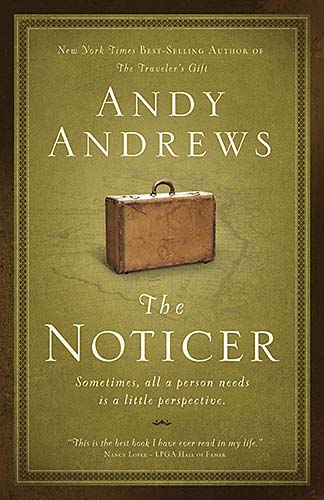
Book Review: The Noticer by Andy Andrews

This book has a great impact on many people. It’s a simple book with thought provoking conversations between a wise older man, “Jones,” and several characters he influences on their journey in life. It is a common sense book and a very enjoyable read, but it leaves out divine reality and truth.

The main character, Jones, is a drifter sort of man who meets individuals in poverty, a failing marriage, old age, failing business and other hopeless situations. Jones helps them see a new perspective to enable them to move forward out of their dire circumstances. Jones offers simple wisdom and hope. For example, in the failing marriage episode, he shares four love languages, which mirror the five love languages that Gary Smalley teaches (Jones doesn’t mention gift giving as a fifth love language). The struggling husband accepts Jones’ advice and returns to his marriage with a fresh perspective and new start. There were several other bits of advice that seem to have a spiritual background, but there is no reference to divine solutions.

One of the penetrating questions Jones’ poses to his listeners is, “What would other people like to change about you?” In other words, what change is necessary in the listener for others to enjoy being around him more? If I am other-centered, as Scripture declares I need to be, then I should consider, reflect and ask others what it might change, so that I can be more effective at building bridges and having a greater influence on others.

Another example is not using “if’s” or “but’s” when asking for forgiveness. For example, if I were to say, “If I hurt you, please forgive me.” That statement doesn’t acknowledge at all that the offender recognizes any offense. It’s really a statement that says, “Let’s get this over with so we can get on with life. You are just very sensitive.” It’s a biblical principle to avoid “if’s” and “but’s” in asking for forgiveness, but the author does not make that connection.

In the same account, Jones asks “Henry” about his unborn child and what name his wife wants to give him. Henry mentions “Caleb” and Jones mentions that the name Caleb is from a noble man who became a ‘victorious old man’ without referring to the biblical account of the story from Joshua 14.

The author, Andy Andrews, invites the reader into realistic conversations that give hope for life. Some of the drama is slow and often the advice very simple. While there are hints of spirituality, neither Jesus Christ nor the grace of God are included as beacons of hope or assurance that God is in control. I enjoyed this casual read as I was not looking for in-depth theology, apologetics, or deep answers to life’s questions.

Book Review: Porn Nation: Conquering America’s #1 Addiction

Porn Nation: Conquering America’s #1 Addiction by Michael Leahy

Michael Leahy was moving successfully through life, until someone with the same problem confronted him, even though he was not willing to admit the problem at first.  The cloud of sin had created such a calloused soul that he didn’t think he was affecting anyone else.  His double life was his double life, until the truth exposed his dark lie and his world came crashing down.

There is no question that Michael had a tough life growing up, although not greatly worse than many others.  His exposure to mild pornography as a young teen was the stimulus that created a desire for more.  The pornography that he fed grew to a huge gorilla in the room that he was not willing to admit until he was out of control and he destroyed his marriage and his relationship with his wonderful young boys.  This is a very sad story, but real enough that it will help many others who have fallen into (dove into) the bondage of pornography.

When Michael found porn on the internet, his valley became deeper than he could imagine and his callused soul was willing to do anything to keep feeding his desire.  This volume will help many who have succumbed to pornography, yet it doesn’t spend enough time giving biblical solutions.

He grew up in a Catholic home and it seems like he switched to another church, North Point Community Church and he references his pastor, Andy Stanley. I would have desired him to explain what he followed to break his life dominating sin, rather than just mention the 12 step program that he joined.  There was so much time spent on the sordid details of his life until the exposure of his sin and relatively little spent on a biblical solution.  I rejoice that he is in a growing marital relationship and that this volume will help many other men identify the potential crossing lines that get a man (or woman) into trouble.

Book Review: Has the Church Replaced Israel?

Has the Church Replaced Israel? By Michael J. Vlach

The relationship between Israel and the Church has been a controversial subject all through Church History, the Church Age.  Some will say that Israel was absorbed into the Church.  They will say there is only one united people of God in history. This is often called Replacement Theology or “supersessionism.”  Some will say, no, there is the Church begun on the Day of Pentecost and while everyone who trusts in Jesus Christ today is part of the Church, the Bride of Christ, including Jews, that Israel is still a people that God will use to fulfill His kingdom purposes by the fulfillment of the Covenants at the Second Advent.
Michael Vlach demonstrates an astute theological understanding and explanation by showing that those who believe the Church replaced Israel have a weak and inadequate case.  He adroitly addresses the Bible, theology and history to reveal supersessionism, Replacement Theology, does not reflect biblical truth.  Some, who believe the Church replaced Israel, also believe that there will be a national restoration of Israel, but only as a nation and without a distinct purpose God has called Israel to fulfill.
Supersessionism is dangerous theology, because it questions the character of God.  If God made an unconditional covenant with Israel that one day they would return to the land, have a Son of David rule on a throne in Israel and bless the world around them, but didn’t really mean that it would happen, then it brings into question the integrity of God. This false interpretation can only result because of symbolic form of interpretation and imposition of typology on the whole of the Old Testament that requires the New Testament for explanation.  In other words, the Old Testament cannot stand on its own for promises made to Israel.
One of the arguments that the Church replaced Israel is called “Punitive Supersessionism,” which states basically the Church replaced Israel because God was punishing Israel (Vlach also addresses economic and structural supersessionism adeptly).  God certainly removed Israel from His blessing for a time, but the Covenants God made with Israel were unconditional and will be literally fulfilled at the Second Advent.
His discussion on the hermeneutics of supersessionism is thorough and objective. Many have argued that Dispensationalists are not really literalists in interpretation, but arguments are usually pointing at literal interpretation of poetry and eschatological passages that use symbols and have been explained in other parts of Scripture.  Replacement Theology does not use a consistent literal hermeneutic, because it foists a system on Scripture rather than letting Scripture speak for itself.  This book is a must read to properly grasp the big picture of understanding the Church does not replace Israel in God’s decree.