Book Review: Pray & Watch by Neal and Judy Brower

Pray and Watch by Neal and Judy Brower is not a new program on prayer.  It is a great book on a lifestyle change.  Fortunately, this lifestyle change is not something that only a few theologically astute can achieve. It is not a concept that only the disciplined dozen will grasp. It is not a concept that only the courageously committed company of those who have walked on terra-firma for fifty or more years can comprehend, but anyone.  Continue reading

Book Review: Successful Home Cell Groups by Dr. Paul Yonggi Cho

Book Review: Successful Home Cell Groups by Dr. Paul Yonggi Cho
“Successful Home Cell Groups” by Paul Yonggi Cho is a great testimony of God’s grace in building His church in South Korea and the influence Cho has had around the world.  Dr. Cho has initiated more projects and influenced more lives that likely any other Christian in our age. He is obviously committed to Jesus Christ and making disciples.  He was so focused on building God’s kingdom on earth that he didn’t need to listen to many others about building a church.  His church numbered about one million in 2007 and he has now turned the church to Dr. Lee Yoon.  This book was written in 1981 when the church was only about 150,000.  He set off with dependency on the Lord with goals in mind.  His goal of numbers drove him to see the largest church built in the world.

He based his growth on two things.  First, he realized if he was going to expand beyond the 2400 he saw his church plateau at, he would need to decentralize the authority.  He did this through home cell groups who came under his authority.  He gave cell leaders his message and training on Wednesday nights.  He then expected from them after the Sunday message, they would build up the people with the Word and love them into the group.  It wasn’t love that was just mentioned, but love that had feet to the actions. 

The home cell groups were the means of outreach.  He exhorted his people to reach out to neighbors and love them in tangible ways.  The examples he gives demonstrate the humility of the people under his ministry.  If anyone wanted to join Cho’s church, they first had to sign up to be a part of a cell group.

The second basis of growth was setting goals with numbers.  He made sure people knew the numbers and they submitted to his authority to reach more people.  I wouldn’t want to take away anything that the Lord has done through his ministry, yet the eastern humility and authority orientation of the Korean culture is off the charts and likely assisted in the expansion.  Yet, he has been effective in many other countries around the world.   He also attributes a great deal of his ministry to the empowerment of the Holy Spirit. 

Some might argue about some of his theologies.  I am always amazed at the reality that some people may not see Scripture exactly as I do.  But what I do respect is the humble results of what God has done through Dr. Cho.  It is incredible and astounding.  You will catch a vision for the possibility of home groups if you haven’t been in one before and you’ll be reinforced to press to the upward call if you already are using home groups.

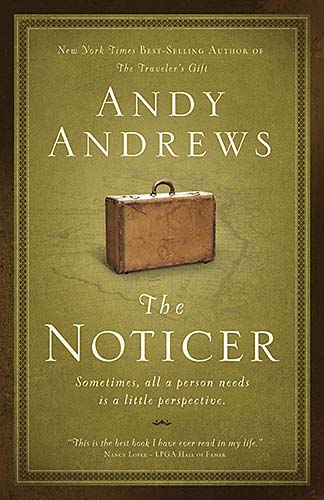
Book Review: The Noticer by Andy Andrews

This book has a great impact on many people. It’s a simple book with thought provoking conversations between a wise older man, “Jones,” and several characters he influences on their journey in life. It is a common sense book and a very enjoyable read, but it leaves out divine reality and truth.

The main character, Jones, is a drifter sort of man who meets individuals in poverty, a failing marriage, old age, failing business and other hopeless situations. Jones helps them see a new perspective to enable them to move forward out of their dire circumstances. Jones offers simple wisdom and hope. For example, in the failing marriage episode, he shares four love languages, which mirror the five love languages that Gary Smalley teaches (Jones doesn’t mention gift giving as a fifth love language). The struggling husband accepts Jones’ advice and returns to his marriage with a fresh perspective and new start. There were several other bits of advice that seem to have a spiritual background, but there is no reference to divine solutions.

One of the penetrating questions Jones’ poses to his listeners is, “What would other people like to change about you?” In other words, what change is necessary in the listener for others to enjoy being around him more? If I am other-centered, as Scripture declares I need to be, then I should consider, reflect and ask others what it might change, so that I can be more effective at building bridges and having a greater influence on others.

Another example is not using “if’s” or “but’s” when asking for forgiveness. For example, if I were to say, “If I hurt you, please forgive me.” That statement doesn’t acknowledge at all that the offender recognizes any offense. It’s really a statement that says, “Let’s get this over with so we can get on with life. You are just very sensitive.” It’s a biblical principle to avoid “if’s” and “but’s” in asking for forgiveness, but the author does not make that connection.

In the same account, Jones asks “Henry” about his unborn child and what name his wife wants to give him. Henry mentions “Caleb” and Jones mentions that the name Caleb is from a noble man who became a ‘victorious old man’ without referring to the biblical account of the story from Joshua 14.

The author, Andy Andrews, invites the reader into realistic conversations that give hope for life. Some of the drama is slow and often the advice very simple. While there are hints of spirituality, neither Jesus Christ nor the grace of God are included as beacons of hope or assurance that God is in control. I enjoyed this casual read as I was not looking for in-depth theology, apologetics, or deep answers to life’s questions.

Book Review: God Space- Where Spiritual Conversations Happen Naturally by Doug Pollock

God Space – Where Spiritual Conversations Happen Naturally by Doug Pollock

There is no singular topic more important than the Good News of Jesus Christ.  Yet that is often the subject that is least brought up in conversations for a variety of reasons.  If both or all parties are Christians, the gospel is often not mentioned, because people view each other as having accepted the good news so there is no sense discussing it more.  When non-Christians are present, it is often not discussed because Christians hope their example will be enough, or they often think others have heard it before so they talk about sports and other things, or Christians want to fit in and not be rejected by the world.  That fear of rejection often comes because Christians have not been equipped to create the environment to discuss the good news.  Doug Pollock draws the reader in to consider many factors about how to make that space of conversation an opportunity to share Christ.  Too often Christians go for the jugular and just move through the gospel without creating thirst on the part of the non-Christian.  We get more focused on information, rather than transformation.  He begins by delineating 10 Spiritual Conversation Killers.  Things like using our language rather than theirs, disrespecting their views, having an agenda to get through the message, or controlling the conversation make people feel boxed in. Then he has four great chapters on “Noticing, Serving, Listening and Wondering Your Way into Spiritual Conversations.”  Each of these chapters put the reader at ease resting in an easier, other-focused way of drawing a person into a spiritual conversation.  His chapter six on “Wondering Your Way into Spiritual Conversations” was especially good in turning the hearers comments into “wondering” questions that allow the non-Christian to be drawn into deeper spiritual conversations about God that they may not have considered.  I appreciate his quote from Howard Hendricks, “Show me a man with a bag full of successes, and I’ll show you a man with a bag full of failures.”  We are successful, because we’ve tried so many times to do it right, but failed over and over.  However, because we persist, we find better ways to do things right and then find success.  Concluding his book, Pollock gives 99 wondering questions to help give many ideas how to get the “other” person talking and drawn into the good news of Jesus Christ.  His approach makes me think of Paul’s comment to the Colossians, “Let your speech always be with grace, seasoned with salt, that you may know how you ought to answer each one.” (Col 4:6)