Words: Spiritual Disciplines (Part 1)

Words: Spiritual Disciplines (Part 1)

Spiritual Disciplines are exercises designed to orient a believer to focus on the Lord Jesus Christ.  They, by themselves, do not cause a person to become more spiritual.  They, by themselves, do not cause God to be obligated to the believer with favor.  They, by themselves, do not propel the believer to spiritual maturity. The disciplines can be functions that an unbeliever can perform and therefore, by themselves, do not produce any merit before God. They would not be categorized by the word “spiritual” in that case. However, practicing spiritual disciplines can help the believer focus on the Word of God, so that in the power of the Holy Spirit, the believer is set apart by faith  in mind, speech and action to become more godly.  Spiritual disciplines can increase a believer’s pursuit of or commitment to the Lord Jesus Christ.

            There are many lists of spiritual disciplines and several authors have written books regarding spiritual disciplines.  Some authors become almost mystical, but most are very practical.  Here is a list of spiritual disciplines that every believer should consider pursuing and putting into practice for their daily walk.  Again, in and of themselves, spiritual disciplines do not produce merit before God, but when done in faith by the power of the Holy Spirit seeking to know our God of Scripture, they are very helpful.

Active Disciplines

Bible Reading: This is probably the most widely known and easiest to do, because you have Scripture to read and focus your attention in order to connect with God.  Scripture is a treasure like none other. Scripture makes a man wise for salvation and life (2 Tim. 3:15-17).  Proverbs tells us wisdom bears far greater fruit than silver or gold (Pro. 3:14; 8: 19).  Jesus confronted temptations quoting Scripture (Luke 4:1-11).  It is living and powerful, sharper than any two-edged sword (Heb. 4:12).  The humanity of Jesus grew learning Scripture (Luke 2:52) and used it to press forward to accomplish God’s will (Luke 22:42).

Bible reading should be done daily, because it is more valuable than food (Matt. 4:4).  When you open Scriptures, tell God, “Your servant is listening” (1 Sam. 3:9-10).  Read Scripture to learn, to grow and to become stable.

Bible Study: This is a much more focused time of analysis, comparison of Scripture with Scripture and acquiring the context of what is written. Bible study is learning the thread through all of Scripture and learning the flow from the books of Genesis to Revelation.  It’s learning how the books of the Old and New Testament are organized.  It’s taking the time to learn, so that you will be ready to teach others also (Matt. 28:20).  Bible study ensures that the text is not taken out of context, so that it becomes a pretext for what you want.  Bible study ensures you study what God has to say rather than man (Is. 55:8-9).

Scripture Meditation: This is thinking deeply about a particular passage of Scripture that you may be studying.  It is interacting with the text and allowing God the Holy Spirit to examine your life, your feelings and your prayers for the purpose of teaching, reproof, correction and instruction in righteousness (2 Tim. 3:16).  It is through meditation that a person slows down enough to hear how the Holy Spirit is leading with conviction and life change. It is a drawing near with the heart in order to know the Lord Jesus Christ, not know about Him, but know Him.  Meditation should be on Scripture as the focus of our attention all day long (Ps. 119:97).  It is the means by which a believer can bypass his teachers in wisdom (Ps. 119:99).  Meditation is sweet to the Lord, because it declares how we are spending our time—our most valuable resource (Ps. 104:34).

Scripture Memorization: This is a commitment of Scripture to memory, especially whole sections, chapters or books of Scripture.  The Psalmist writes, “Your Word I have hidden in my heart, That I might not sin against You!” (Ps. 119:11)  There are many ways to memorize Scripture.  Going over and over the text is similar to the way Ezra studied Scripture (Ezra 7:10).  Meditating on passages can set Scripture to memory through associations of concepts.  The time of memorizing is a great tool for the Holy Spirit to set our lives apart to Jesus Christ.  Memorizing passages can give great hope in crises.  For example, memorize James 3:1-12 to learn control of the tongue, 1 Corinthians 13:4-8 to learn the spectrum of love and what constitutes sin when not practiced, Ephesians 1 to gain an understanding of God’s eternal plan and His sovereign control of history, Phil. 4:6-9 to fight against worry and gain a foothold so the peace of God reigns in your life, or Psalm 23 as a passage of comfort and hope in trouble, or Philippians 3:7-14 for a passage on motivation to pursue Jesus Christ, or Psalm 1 for a great passage teaching children what to delight in and what to avoid, or 1 John 1 for a passage on walking in the light with God.

Prayer: This is talking with God about what we are experiencing and doing together in life.  Prayer is the vertical relationship in life.  It is the trust and dependence on the God of the Universe.  It is not as easy as some people say, because it is often developed as other spiritual disciplines are learned. Jesus often went out to pray alone (Mark 1:35; Luke 6:12; 9:18; 11:1). He has a praying life rather than a prayer life. There are great prayers in Scripture like morning prayers of Psalm 3 & 4 and the evening prayer of Psalm 5. The Lord’s Prayer is found in John 17.  Paul’s greatest prayer is Ephesians 3:14-21. 

Prayer often can follow the ACTS or the CAST pattern, where the respective letters stand for Adoration; Confession, Thanksgiving and Supplication.  The CAST acrostic is given for those who insist that confession should be done first.   Prayers using Scripture are very wise, because that keeps you focused on God’s desires. Prayer partners often support and hold accountable prayer requests and can rejoice at answered prayers. Prayer walks are helpful to gain focus and allow the beauty of creation or a circumference boundary to receive the indirect artillery of prayer.

            These are merely the first five spiritual disciplines.  Succeeding descriptions will follow regarding the spiritual disciplines of:

Solitude; Submission; Silence; Fasting; Service; Worship; Fellowship; Reflection; Sabbath Rest; and Frugality.

Men: Raising Men (3)

Men: Raising Men (3)

As go the men, so goes the church.  There is not a verse in Scripture for that, but there are many allusions to the importance of men in raising men.  Men have a tough role of providing for their family and leading them spiritually.  It’s easy to relegate spiritual responsibility to the mother, especially if she is not working.  The man works hard all day and is tired when he comes home.  He’s looking for ways to make life easier.  Patience and perseverance in raising children in godly ways is not easy.
It happened almost two hundred years ago that Sunday Schools were founded.  Prior to that, family spiritual growth depended on parents and the pastor, as children sat with their parents in church.  But in the early 1800s, a great assist was founded for helping families and it was structured within the church.
“Whereas in 1820 Protestants had thought about children’s religious experiences primarily in terms of family and church, by 1880 it was impossible to conceive of them without reference to the Sunday school. During the nineteenth century, this new institution became the primary locale – outside of the family – for religious indoctrination of Protestant youth. In the annals of church history the saga of Sunday school was unique, involving…the creation of a new institution to fulfill functions previous entrusted to parents and pastors…” – Ann Boylan (provided by Jeremy Thomas) 

While Sunday school is a good thing, man and parents, generally speaking, transferred spiritual development to Sunday School over a period of 60 years.  There was nothing intentional or evil in the initiation of Sunday School.  It was a great blessing to many parents, especially parents who were not discipled by their own parents.  Yet, slowly, families became dependent on Sunday School in the church and less spiritual training was accomplished in the home.  After all, that way there was less conflict in the home and parents would support Sunday School teachers. 

            Furthermore, youth ministry has had an abundance of youth ministry aids, like youth pastors, magazines and music and while youth leaders are pouring their hearts into the youth, the expected results are not as visible.  Alvin Reid observes, 

 “It is obvious that youth ministry in America has not produced a generation of young people who are passionate about the church…the number of full time youth pastors has grown dramatically and a plethora of magazines, music, and ideas aimed at youth have been birthed along the way.  Meanwhile…the numbers of young people won to Christ dropped at about as fast a rate.” – Alvin Reid (provided by Jeremy Thomas)

It might look like the problem exists with the youth ministry.  In most cases not at all. Youth ministries are thinking of everything they can to help raise young people.  The problem rests with the family. Families are not raising up men and women that are hungering for truth and passionate about service.  There are many zealous youth, but not like the youth of 40 years ago. 

            We have to place responsibility where God places it.  Solomon exhorts his sons to listen and take heed to his teaching, 

Hear, my children, the instruction of a father, And give attention to know understanding;
 2 For I give you good doctrine: Do not forsake my law.
 3 When I was my father’s son, Tender and the only one in the sight of my mother,
 4 He also taught me, and said to me:  “Let your heart retain my words; Keep my commands, and live.
 5 Get wisdom! Get understanding! Do not forget, nor turn away from the words of my mouth. (Pro. 4:1-5) 

Fathers are responsible to exhort and be diligent to teach their children (Deut. 6:1-9).  Unfortunately, when children do not respond or worse, rebel, parents let their responsibility slide, because they do not want conflict and do not know how to raise children to the holiness of God.  As children become indifferent, fathers become indifferent to God’s mandates to raise up godly children,  

4 And you, fathers, do not provoke your children to wrath, but bring them up in the training and admonition of the Lord. (Eph. 6:4) 

When fathers become indifferent, they are in rebellion against God’s calling and God’s mandate.   

            I would never blame Sunday School for the state in which we are living now.  The responsibility rests solely with the family and specifically with us fathers.  Are you willing to teach Father greatness to your children?1 Are you willing to take your rightful position as head of your family and lead them to the throne of grace?   

            Let’s not blame anyone else for whether our children are following the Lord or not.  Let’s take personal responsibility and man-up to God’s calling.  If you have any questions or need mechanics, let me know. 

1See the message delivered on March 17 and posted on March 18, 2013, “Get a Grip on Father Greatness.”

Men: Raising Men (2)

Men: Raising Men (2)


What is the effect of fatherless homes?  One person wrote,

In reality the world is as full of bad mothers as it is of bad fathers, and it is not the motherless children who become delinquent but the fatherless ones. (Louis de Bernieres)

That may be a general statement with plenty of exceptions, but it does expose the importance of the father’s role in the life of children.   It is likely why James emphasizes the importance of ministry to orphans when he writes,

Pure and undefiled religion before God and the Father is this: to visit orphans and widows in their trouble, and to keep oneself unspotted from the world. (Jam. 1:27)

Orphans (and widows) are much more vulnerable, because there is not the one (the godly husband or the godly father) God designed to protect them.  God designed from the beginning that every child should have two parents – a man and a woman – in the home.  Children learn roles and responsibilities from both parents.  It is difficult to learn those roles if one of the parents is not present. The problem is the hearts of fathers and children are often separated by problems of sins.  In the last book of the Old Testament, God promises that one day He will restore the hearts of the fathers to their children,

5 Behold, I will send you Elijah the prophet Before the coming of the great and dreadful day of the LORD.  6 And he will turn The hearts of the fathers to the children, And the hearts of the children to their fathers, Lest I come and strike the earth with a curse. (Mal. 4:5-6)

After Malachi spoke, there was a period of 400 years of silence from God.  There was so much conflict and rebellion between people, including fathers and children, that God was silent. 

            We live in a day when more and more children are growing up in fatherless homes.  It’s interesting to note the influence of not having fathers in a home.  The National Center for Fathering records1,

Fatherless Homes Produce:
  • 90% of Runaway Children
  • 85% of Children With Behavior Problems
  • 71% of High School Drop Outs
  • 70% of Juvenile Detentions
  • 75% of Children Addicted to Drugs
  • 63% of Teenage Suicides
  • 80% of Rapists
  • 85% of Prison Inmates

Additionally the following sources provide interesting considerations2:

Educational Attainment. Kids living in single-parent homes or in step-families report lower educational expectations on the part of their parents, less parental monitoring of school work, and less overall social supervision than children from intact families. (N.M. Astore and S. McLanahan, American Sociological Review, No. 56 (1991)

Confused Identities. Boys who grow up in father-absent homes are more likely that those in father-present homes to have trouble establishing appropriate sex roles and gender identity.(P.L. Adams, J.R. Milner, and N.A. Schrepf, Fatherless Children, New York, Wiley Press, 1984).

Aggression.In a longitudinal study of 1,197 fourth-grade students, researchers observed “greater levels of aggression in boys from mother-only households than from boys in mother-father households.” (N. Vaden-Kierman, N. Ialongo, J. Pearson, and S. Kellam, “Household Family Structure and Children’s Aggressive Behavior: A Longitudinal Study of Urban Elementary School Children,” Journal of Abnormal Child Psychology 23, no. 5 (1995).

Achievement.Children from low-income, two-parent families outperform students from high-income, single-parent homes. Almost twice as many high achievers come from two-parent homes as one-parent homes. (One-Parent Families and Their Children, Charles F. Kettering Foundation, 1990).

Delinquency.Only 13 percent of juvenile delinquents come from families in which the biological mother and father are married to each other. By contract, 33 percent have parents who are either divorced or separated and 44 percent have parents who were never married. (Wisconsin Dept. of Health and Social Services, April 1994).

Criminal Activity. The likelihood that a young male will engage in criminal activity doubles if he is raised without a father and triples if he lives in a neighborhood with a high concentration of single-parent families. Source: A. Anne Hill, June O’Neill, Underclass Behaviors in the United States, CUNY, Baruch College. 1993

The need of fathers is clear both statistically, but primarily from God’s Word. Fortunately, God sends hope.  That hope is in Jesus Christ.  He is the solution to our problems and woes.  He is the solution to fatherless homes.  He is the solution to draw fathers to children.  Are you walking with Him?


1What Can the Federal Government Do To Decrease Crime and Revitalize Communities?” The National Institute of Justice, 1998.


Men: Raising Men (1)

Men: Raising Men (1)

I recently read this quote from one of my favorite Presidents:

“In any situation, the best thing you can do is the right thing; the next best thing you can do is the wrong thing; the worst thing you can do is nothing.”
– Theodore Roosevelt

We often don’t do anything, because we want to do the right thing.  We often don’t do anything, because there are so many options that we can’t decide which one to choose.  We often don’t do anything, because we don’t understand our role as leaders and will let someone else lead.  Men have lived that pattern ever since Adam and Eve failed in the Garden of Eden.

When Adam should have been leading and protecting, he stood on the sidelines and let Eve (as she would later be called) lead.  She was conversing with the serpent and Adam should have been protecting her, 

Now the serpent was more cunning than any beast of the field which the LORD God had made. And he said to the woman, “Has God indeed said,`You shall not eat of every tree of the garden’?” 2 And the woman said to the serpent, “We may eat the fruit of the trees of the garden; 3“but of the fruit of the tree which is in the midst of the garden, God has said,`You shall not eat it, nor shall you touch it, lest you die.'” 4 Then the serpent said to the woman, “You will not surely die. 5 “For God knows that in the day you eat of it your eyes will be opened, and you will be like God, knowing good and evil.” 6 So when the woman saw that the tree was good for food, that it was pleasant to the eyes, and a tree desirable to make one wise, she took of its fruit and ate. She also gave to her husband with her, and he ate. (Gen. 3:1-6)

That’s what happens when a man stands on the sideline and does nothing.

            There are also horrible things that happen in the home today when a man does not fulfill his role as a father. Note these statistics:

For every 10 men in the average church…

• 9 will have kids who leave the church

• 8 will not find their jobs satisfying

• 6 will pay monthly minimum on credit cards

• 5 have a major problem with pornography

• 4 will get divorced affecting 1,000,000 children each year

• Only 1 will have a biblical worldview

• All 10 will struggle to balance family & work: Because they really want to HAVE FUN!  (Provided by Pastor Bruce Einspahr)

We need to raise men to be men and understand the Father’s business: raising men to be true men.  Right now families are content if there is somecommunication.  God wants us to build into young men God the Father’s priorities and life.  That comes through 1) learning to love God with all of our heart, soul and strength; 2) hiding the Scriptures into our heart; and 3) being diligent to teach our children and the children around us to become disciples of Jesus Christ (Deut. 6:1-15).

            What is your part in the process?  Are you content standing on the side?  Are you content watching America go down the spiral of the immorality morass and the vacuum of emptiness?  Are you willing to step up to your God-given role of raising men to be godly men who will raise generation after generation of godly people?  Don’t wait.  Get going now.

Men: Men Leading Men (1)

Men: Men Leading Men (1)

There is a scarcity of men in spiritual leadership today.  It is really nothing new.  The scarcity began back in the Garden of Eden, when Adam stood near the woman (later called Eve) and watched the devil deceive her.  He did nothing to prevent the attacks on God’s character and God’s Word.  The devil challenged the woman and like most women, she was up for the challenge, but she came up short.  Why?  She came up short that is, because she failed to depend on the character and will of God, because her protector, Adam, did not lead. 

            Yes Adam was standing with her, because when she ate of the fruit she gave the fruit to Adam also.  Moses records the text in Genesis 3:6, “So when the woman saw that the tree was good for food, that it was pleasant to the eyes, and a tree desirable to make one wise, she took of its fruit and ate. She also gave to her husband with her, and he ate. (Gen. 3:6, emphasis mine)  He was right there, but he stood by and like many men today continue to stand by on the sidelines rather than entering into the battle of life. How do we turn this around?  We must reach men and disciple them to godliness.

            There are blatantly challenging statistics regarding our current culture.  Bruce Einspahr reported recently as a pastor’s conference about the profession of faith in several generations.  He cited from the Billy Graham Organization:

·         65% of those in the Builder generation have trusted Christ

·         35% of those in the Boomer generation have trusted Christ

·         15% of those in the Gen-X generation have trusted Christ

·         4% of the kids alive today will make a profession of faith. 

Those are significant statistics and may reveal why America is suffering spiritually and we see downward results in many other venues, like morality, social, economic and political arenas.  If we don’t reach each generation, the USA will become a second rate country, because it will lose its blessing God granted through the founding fathers.  It was the founding fathers who instilled biblical values in their families, but life happens and the values have changed.  In fact, the values are spirally down so quickly that only a revival will turn things around.  

            I’ll address this in the next article of Men Leading Men, especially as it relates to the father of the family influence.

Reconciled to God

I’m going to give you a quote that is utterly fantastic.  It’s a little long, but bear with me and you will greatly advance in spiritual understanding. It’s helpful to understand the antimony of God’s sovereignty and Man’s freewill.  An antimony is an apparently unresolvable conflict or contradiction, especially between two true statements.  For example, Scripture declares that God is Sovereign.  Scripture also declares that man has free will.  If one is true, the other cannot be some will say.  It’s like God is one and God is three.  Both are true statements, but man’s finite mind cannot fully understand, except by accepting them both by faith and making our best understanding of both true statements.

This is a quote that helped me greatly understand the antinomy of God’s sovereign work in salvation and man’s non-meritorious choice. It’s a quote from Merrill Unger who wrote Unger’s Bible Dictionary.  He defines what the word “reconcile.” He explains what God did to restore man to Himself.  Read this and I’ll break it down.

“Reconcile comes from a word that means to change thoroughly from one position to another (Eph. 2:16; Col. 1:20-21). It means that someone is completely altered and adjusted to a required standard. (Rom. 5:6-11).  By the death of Christ, the world is changed in its relationship to God. Man is reconciled to God, but God is not said to be reconciled to man.  By this change lost humanity is rendered savable.  As a result of the changed position of the world through the death of Christ, the divine attitude toward the human family can no longer be the same.  God is enabled to deal with lost souls in the light of what Christ has accomplished.  Although this seems to be a change in God, it is not a reconciliation; it is rather a ‘propitiation.’ God places full efficacy in the finished work of Christ and accepts it. Through His acceptance of it He remains righteous and the justifier of any sinner who believes in Jesus as his reconciliation.  When an individual heart sees and trusts in the value of Christ’s atoning death, he becomes reconciled to God, hostility is removed, friendship and fellowship eventuate.” 

            Let me break that down for you. 

“Reconcile comes from a word that means to change thoroughly from one position to another (Eph. 2:16; Col. 1:20-21). It means that someone is completely altered and adjusted to a required standard. (Rom. 5:6-11). 

He is saying that the word “reconcile” means that by the death of Christ on the cross, God changes a person to a completely altered state related to God and adjusts that person to the required standard of God.  What is God’s standard?  His own righteousness.  Because Jesus died on the cross for the sins of man, paying the penalty of sin, man is altered and adjusted to the righteousness of God.  Listen to what Paul writes in Romans,

10 For if when we were enemies we were reconciled to God through the death of His Son, much more, having been reconciled, we shall be saved by His life. 11And not only that, but we also rejoice in God through our Lord Jesus Christ, through whom we have now received the reconciliation. (Rom. 5:10-11)

We were considered as enemies by God, but because of the cross, we were altered and adjusted to the required standard. The sin barrier was removed by Jesus’ death, so that God could now look at man in a different way. Note that last phrase, “we received the reconciliation.” We’ll see that below. It is the part man must do for the fullness of reconciliation. Then Unger says,

By the death of Christ, the world is changed in its relationship to God. Man is reconciled to God, but God is not said to be reconciled to man.  By this change lost humanity is rendered savable.

Here the change is caused by the death of Jesus on the cross, Who died for our sins.  Notice he says that man is reconciled to God, but nowhere does it say in Scripture that God is reconciled to man.  THAT is very significant.  Furthermore, man is then placed in a “savable” condition, whereby man can be saved.  Man has been placed in an altered condition and adjusted to the righteousness of God and rendered savable.  But man is not saved at that point, because there is a second part of the reconciliation that is necessary.

            Unger continues addressing the relationship,

As a result of the changed position of the world through the death of Christ, the divine attitude toward the human family can no longer be the same. 

Because of the death of Jesus, God’s attitude had to change toward mankind.  It couldn’t be the same. Why couldn’t it remain the same, that is, considering man as an enemy (Rom. 5:10)?

God is enabled to deal with lost souls in the light of what Christ has accomplished.  Although this seems to be a change in God, it is not a reconciliation; it is rather a ‘propitiation.’

Because of the death of Jesus, God is enabled to deal with fallen man. How does that work?  Because God’s righteousness was propitiated – satisfied.  Legally, the penalty for sins was paid by Jesus and God was satisfied with His death payment.  However, there hasn’t been a full reconciliation, because a second part is necessary.  God was satisfied with the death of Jesus for the sins of the world, so God could no longer look at man as an enemy, but a soul waiting to accept what God had done for him.   Catch this next section,

God places full efficacy in the finished work of Christ and accepts it. Through His acceptance of it He remains righteous and the justifier of any sinner who believes in Jesus as his reconciliation. 

Jesus did the work.  God makes effective, or considers of great value, the work of Christ. Why?  Because God the Father accepted the work of Jesus on the cross and therefore can place man in a position of being justified, if man makes a non-meritorious decision of faith to accept what Jesus has done, that is believe in Jesus as his reconciliation.  Finally, Unger says,

When an individual heart sees and trusts in the value of Christ’s atoning death, he becomes reconciled to God, hostility is removed, friendship and fellowship eventuate.” 

So God calls you to salvation and waits on you to put your faith in Jesus Christ as your Savior.  When you do, then the fullness of the hostility is removed and you can grow in fellowship with God.  That is deep, I know, but is utterly important to understand as you grow in your relationship with the Lord Jesus Christ.

            Consider how that helps understand the antinomy described above.


Forgiveness: Restoring Relationships God’s Way

Restoring Relationships God’s Way

Beginning in the beginning, there have been problems and conflicts in relationships.  If Adam and Eve had conflicts, and we see it all through Scripture, then it’s pretty likely that even the best relationships will have conflicts.  It all results because of sin in the world. The creature is born centered on self and it takes divine enablement to truly focus and serve others. So the question is not what do I do IF it happens, but what do I do WHEN it happens.

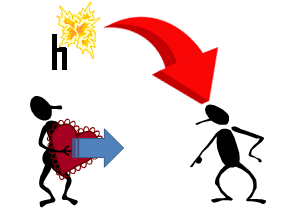
This first slide shows the reality of some problem between two people.  It can be two or a mob.  Whatever the relationship, there is going to be some kind of conflict.  (I know these are in a cartoon form, but let’s try to get the principle)

The human response is often to lash back or internalize and “carry” the pain OR a multitude of options in between those two actions.  Often, our response to someone is sin.  For example if I lash back at someone for sinning against me, I have just sinned.  Yes, even though I didn’t start it, I chose to respond in sin and think that I could solve the problem my way.  Sometimes it’s the sin of reaction and sometimes it’s the sin of internalization.  Both are wrong responses.

Instead I need to choose the biblical approach and forgive.  One of the Hebrew words for forgive is nasah, which means “to lift up.”  A second Hebrew word is salah, which means “ready to pardon.”  Both give a good picture of what we are supposed to do. Lift the sin (the penalty and pain of the sin) to the throne of God for Him to deal with it.  A third forgive word is a Greek word aphia-mi, which literally means “to send away.”  God wants us to send away to Him the sin pain and let Him deal with it.  We are not very judicial with offenses against ourselves.  Our flesh reacts and does all sorts of strange things, like think we are as smart as God.

“Lifting up” and “ready to pardon” demonstrate the ready attitude to lift it up to God.  The phrase “send away” means that I’m not going to deal with it against the offender, because I will trust the Lord to deal with it. 

In the next slide the offended person chooses to forgive, that is lifts up or sends away the penalty to the throne of God.  The black symbol with the yellow burst is supposed to be a  chair or throne as an illustration of the Shekinah Glory described in the Old Testament or the Presence of God in heaven.

Lifting up the conflict to the Lord fits well with 1 Peter 5:7, which says “casting all your cares on the Lord, for He cares for you.”  I first deal vertically with the problem and is the principle taught in Mark 11:25, “And whenever you stand praying, if you have anything against anyone, forgive him, that your Father in heaven may also forgive you your trespasses. (Mar 11:25)  Once you choose to deal with the problem vertically, then you can begin to deal with the horizontal relationship.

You may still feel the pain of the offense.  The relationship may still be struggling.  But you, because you’ve given it to God, you can choose to have a heart of love toward the offender.  That’s the third slide below.  Notice that God will deal with the other person in His way.  Unfortunately, it may not be in your timing.  It may not be in your lifetime.  Yet, God is infinite in wisdom, justice, power and mercy to know how best to deal with the relationship.  His way is far better than anything we can consider (Is. 55:8-9). The key is you now are able to have a heart of love toward the other person.  This is also the principle from 1 Peter 4:8, “And above all things have fervent love for one another, for “love will cover a multitude of sins.”  It’s covered, because you trust in the covering of the blood of Christ on the cross.


When a person lifts up the offense to God, he can have a heart of love toward the offender.  The person no longer has to have any kind of revenge desire, because he’s given it to God. It is a choice, to love at this point, but it is what God desires according to Luke 17:3-10; Matthew 18:15-17; Romans 12:14-21; and 1 Peter 3:8-12.

The last slide shows that God may want you to make the decision to reach out to the offender, or even confront the offender.  IF God is working through you to the offender it will be God’s love.  It may be firm and deliberate, because sin may need to be confronted (Luke 17:3-4), but it is done from God’s love, not personal vengeance (Romans 12:15-21)
 

These slides are a simplistic way of looking at forgiveness.  They do not answer all the questions in a relationship.  They begin the process of dealing with forgiveness. 

Do they help you?

Restoring Relationships for Him

Relationships: Restoring Relationships for Him
Matthew 18

This message is on restoring relationships, but the basis for restoring relationships  from man’s perspective begins with forgiveness.  Here’s a skit that explains man’s way of forgiveness. [ the skit actually shows how we often fall short of God’s way of forgiveness and we botch it.]

 Forgiveness is often tried, but often it falls short of what God intends. Relationships will push you beyond you.  They will take you beyond the range of your natural abilities and beyond the borders of your natural and acquired wisdom. That is part of God’s plan.  But also part of God’s plan is to see what can happen from God’s abilities. What would it take on your part for others to see Christ at work in your life? How can others see that you are a disciple of Jesus?  One of the greatest miracles is restoration of relationships, because it doesn’t often happen in everyday life. Why do you need to restore relationships?

            Normally, we think of forgiveness and restoration of relationships as a good thing to do from Scripture, because it helps us get along with people.  It helps in families, at work and at church for us to get along.  Is that why God wants us to forgive and restore relationships?  There is a much higher reason.  The first basis is because that is the pattern God established.  If we want to imitate God, and every believer is commanded to imitate God (Eph. 5:1), then we must mirror His pattern.

1)      God reconciled the world to Himself as our pattern 2 Cor. 5:18-19


I’m going to give you a quote that is utterly fantastic.  It’s a little long, but bear with me and you will greatly advance in spiritual understanding. It’s helpful to understand the antimony of God’s sovereignty and Man’s freewill.  An antimony is an apparently unresolvable conflict or contradiction, especially between two true statements.  For example, Scripture declares that God is Sovereign.  Scripture also declares that man has free will.  If one is true, the other cannot be some will say.  It’s like God is one and God is three.  Both are true statements, but man’s finite mind cannot fully understand, except by accepting them both by faith and making our best understanding of both true statements.

This is a quote that helped me greatly understand the antinomy of God’s sovereign work in salvation and man’s non-meritorious choice. It’s a quote from Merrill Unger who wrote Unger’s Bible Dictionary.  He defines what the word “reconcile.” He explains what God did to restore man to Himself.  Read this and I’ll break it down.

“Reconcile comes from a word that means to change thoroughly from one position to another (Eph. 2:16; Col. 1:20-21). It means that someone is completely altered and adjusted to a required standard. (Rom. 5:6-11).  By the death of Christ, the world is changed in its relationship to God. Man is reconciled to God, but God is not said to be reconciled to man.  By this change lost humanity is rendered savable.  As a result of the changed position of the world through the death of Christ, the divine attitude toward the human family can no longer be the same.  God is enabled to deal with lost souls in the light of what Christ has accomplished.  Although this seems to be a change in God, it is not a reconciliation; it is rather a ‘propitiation.’ God places full efficacy in the finished work of Christ and accepts it. Through His acceptance of it He remains righteous and the justifier of any sinner who believes in Jesus as his reconciliation.  When an individual heart sees and trusts in the value of Christ’s atoning death, he becomes reconciled to God, hostility is removed, friendship and fellowship eventuate.” 

            Let me break that down for you. 

“Reconcile comes from a word that means to change thoroughly from one position to another (Eph. 2:16; Col. 1:20-21). It means that someone is completely altered and adjusted to a required standard. (Rom. 5:6-11). 

He is saying that the word “reconcile” means that by the death of Christ on the cross, God changes a person to a completely altered state related to God and adjusts that person to the required standard of God.  What is God’s standard?  His own righteousness.  Because Jesus died on the cross for the sins of man, paying the penalty of sin, man is altered and adjusted to the righteousness of God.  Listen to what Paul writes in Romans,

10 For if when we were enemies we were reconciled to God through the death of His Son, much more, having been reconciled, we shall be saved by His life. 11And not only that, but we also rejoice in God through our Lord Jesus Christ, through whom we have now received the reconciliation. (Rom. 5:10-11)

We were considered as enemies by God, but because of the cross, we were altered and adjusted to the required standard. The sin barrier was removed by Jesus’ death, so that God could now look at man in a different way. Note that last phrase, “we received the reconciliation.” We’ll see that below. It is the part man must do for the fullness of reconciliation. Then Unger says,

By the death of Christ, the world is changed in its relationship to God. Man is reconciled to God, but God is not said to be reconciled to man.  By this change lost humanity is rendered savable.

Here the change is caused by the death of Jesus on the cross, Who died for our sins.  Notice he says that man is reconciled to God, but nowhere does it say in Scripture that God is reconciled to man.  THAT is very significant.  Furthermore, man is then placed in a “savable” condition, whereby man can be saved.  Man has been placed in an altered condition and adjusted to the righteousness of God and rendered savable.  But man is not saved at that point, because there is a second part of the reconciliation that is necessary.

            Unger continues addressing the relationship,

As a result of the changed position of the world through the death of Christ, the divine attitude toward the human family can no longer be the same. 

Because of the death of Jesus, God’s attitude had to change toward mankind.  It couldn’t be the same. Why couldn’t it remain the same, that is, considering man as an enemy (Rom. 5:10)?

God is enabled to deal with lost souls in the light of what Christ has accomplished.  Although this seems to be a change in God, it is not a reconciliation; it is rather a ‘propitiation.’

Because of the death of Jesus, God is enabled to deal with fallen man. How does that work?  Because God’s righteousness was propitiated – satisfied.  Legally, the penalty for sins was paid by Jesus and God was satisfied with His death payment.  However, there hasn’t been a full reconciliation, because a second part is necessary.  God was satisfied with the death of Jesus for the sins of the world, so God could no longer look at man as an enemy, but a soul waiting to accept what God had done for him.   Catch this next section,

God places full efficacy in the finished work of Christ and accepts it. Through His acceptance of it He remains righteous and the justifier of any sinner who believes in Jesus as his reconciliation. 

Jesus did the work.  God makes effective, or considers of great value, the work of Christ. Why?  Because God the Father accepted the work of Jesus on the cross and therefore can place man in a position of being justified, if man makes a non-meritorious decision of faith to accept what Jesus has done, that is believe in Jesus as his reconciliation.  Finally, Unger says,

When an individual heart sees and trusts in the value of Christ’s atoning death, he becomes reconciled to God, hostility is removed, friendship and fellowship eventuate.” 

So God calls you to salvation and waits on you to put your faith in Jesus Christ as your Savior.  When you do, then the fullness of the hostility is removed and you can grow in fellowship with God.  That is deep, I know, but is utterly important to understand as you grow in your relationship with the Lord Jesus Christ.


            Now, you may have been offended, harmed, hurt, or attacked by another Christian, even one in authority, like a husband, elder or pastor.  I don’t know the circumstances of your event, but I know they happen and they can cause great harm and pain.  But let me tell you about the One who has never offended or attacked.  Let me tell you about the One who reconciles, because at the base of reconciliation is forgiveness. Listen to the greatness of my Lord.

            It’s my Lord’s character to forgive,

16 “But they and our fathers acted proudly, Hardened their necks, And did not heed Your commandments. 17 They refused to obey, And they were not mindful of Your wonders That You did among them. But they hardened their necks, And in their rebellion They appointed a leader To return to their bondage. But You are God, Ready to pardon, Gracious and merciful, Slow to anger, Abundant in kindness, And did not forsake them. (Neh. 9:16-17)

We get a clear picture of Israel’s hardness and rebellion.  They even wanted to go back to the slave market of Egypt, even though God promised a land full  of milk and honey.  Even though they were stiff-necked, God was ready to pardon and merciful.  It makes a Christian want to sing of the mercy of the Lord forever! 

            When God forgives, it’s complete,

10 He has not dealt with us according to our sins, Nor punished us according to our iniquities.  11 For as the heavens are high above the earth, So great is His mercy toward those who fear Him; 12 As far as the east is from the west, So far has He removed our transgressions from us. (Ps. 103:10-12)

My God hasn’t treated me, or you, the way I deserve.  In fact, He removes my sins an infinite distant, as far as the east is from the west, because of Christ’s sufficient death on the cross. Additionally, there is a great illustration in Isaiah 38 about how God deals with my sin.  God speaks through Isaiah to Hezekiah to get his house in order because Hezekiah is going to die.  Well, Hezekiah is not ready to go and becomes very bitter about it.  He goes into his bedroom and faces the wall and weeps.  But he comes to his senses and he is filled with peace, because he realizes what God has done with his sins.

17 Indeed it was for my own peace that I had great bitterness; But You have lovingly delivered my soul from the pit of corruption, for You have cast all my sins behind Your back. (Is. 38:17)

 The picture Isaiah gives is of God taking my sins and putting them in the small of His back.  That is a place that you know is there, but you can’t see it.  God doesn’t look at my sins after they have been dealt with.  That’s the mercy of my God!  In Hebrews we have another aspect of how God deals with us.

14 For by one offering He has perfected forever those who are being sanctified.  15 But the Holy Spirit also witnesses to us; for after He had said before, 16“This is the covenant that I will make with them after those days, says the LORD: I will put My laws into their hearts, and in their minds I will write them,” 17 then He adds, “Their sins and their lawless deeds I will remember no more.” (Heb. 10:14-17)

God doesn’t forget our sins, He chooses not to remember them.  God is all knowing, or omniscient, so He cannot forget our sins.  Fortunately, He chooses not to remember them.  Finally, God’s infinite forgiveness costs me nothing, “For He made Him who knew no sin to be sin for us, that we might become the righteousness of God in Him.” (2 Cor. 5:21)  It was free to me, but cost the death of the Lord Jesus.  That’s what God is like!  He is ready to pardon, therefore we ought to be ready to pardon people also.  IT IS not easy.  It takes God the Holy Spirit to soften our hearts, and the decision of the will to forgive and begin the restoration process.  There is a second reason why Jesus wants you to restore relationships. 

2)      Restoring relationships is more important than worship  Matt. 5:23-24

             Does that make sense?  What could be more important that worship?  Isn’t that what God calls us to do?  Worship Him?  There is something more important according to the Lord Jesus.

23 “Therefore if you bring your gift to the altar, and there remember that your brother has something against you, 24 “leave your gift there before the altar, and go your way. First be reconciled to your brother, and then come and offer your gift. (Matt. 5:23-24)

That is what Jesus said.  He said, if you are coming to worship God, and you remember that a brother has something against you, then first go seek to restore the relationship, and then come back and worship.  That means we need to forgive, even when/if the other person hasn’t done what he needs to do.  Paul says it well,

31 Let all bitterness, wrath, anger, clamor, and evil speaking be put away from you, with all malice. 32 And be kind to one another, tenderhearted, forgiving one another, just as God in Christ forgave you. (Eph. 4:31-32)

I need to put off any bitterness and anger and put on forgiveness if I’m going to restore a relationship.  I’m going to have to forgive.  What does that mean? 

            Forgiveness is used many ways and this message only begins to address forgiveness.  There are three main words for the word, “forgiveness.”  The first is a Hebrew word, “nasah,” which means to “lift up.” You can remember the word because it sounds like NASA, which lifts rockets to space.  The second Hebrew word is “salah” which means “ready to forgive.”  God is ready and waiting on us and wants us ready and waiting on others to restore the relationship. The third word is a Greek word “aphia-mi,” which means “to send away.”  God wants us to send away the penalty of the offense from someone else away to God. That way we let God deal with the offense of the person toward us and we can trust God to do the right thing.  God is much better at helping people see their wrong, than we are!

            There are four slides at the end of the message that explain this process.  When we send the penalty and pain to God, then we are free to be in a position to love the person.  We are satisfied that God can deal with the person.  In fact, God may lead us to be a part of the restoration process.  We may need to act for the person by expressing love toward him.  That love takes the direction of Jesus and empowerment by the Holy Spirit.

            What does that look like?  Let me use Matthew 18 as the illustration that Jesus wants us to restore relationships more than even approaching Him in worship.

            In Matthew 18, the disciples are discussing with themselves who is the greatest and they approach Jesus and say, “Jesus, who is going to be the greatest in the Kingdom?”  Jesus takes a little child and putting the child in front of them, He says, “Unless you are converted and become like this child, you will not enter into the Kingdom of Heaven.”  He added, “And so whoever humbles himself like this child is the greatest in the Kingdom. And whoever receives this child in My name, receives Me.”  In other words, this is available to all people. All people can be restored, but it takes the humility of a child who trusts in the one in authority.

            Jesus wanted the disciples to understand how serious sin is, so He continues to say that whoever causes one of the little ones to sin, well it would be better to have a millstone put around his neck and be cast into the sea, so you can’t cause anyone else to sin.  It’s a horrible thing to cause another to sin. 

            Then Jesus describes the seriousness of sin with an hyperbole. He says, that if your hand or foot causes you to stumble, cut it off.  It would be better to enter the Kingdom with one hand or foot, than to have two and be cast into the everlasting fire.  Or if your eye causes you to stumble (maybe through pornography or window shopping and lusting after wanting more clothes), to pluck it out, for it would be better to enter into the Kingdom with one eye than to have two eyes and be cast into hell fire.  But Jesus doesn’t just stand there like a stern judge.  No He reveals the compassion we all need to have toward others.

            He continues saying, if a shepherd has 100 sheep and one sheep strays away.  He will leave the 99 to seek the one.  And when he finds the one, he will rejoice more than having the 99.  That’s a big deal!  So we should have that kind of compassion that the Father has toward all people.

            Forgiveness also includes the process of dealing with sin in a gracious and orderly way.  Jesus describes a case where a brother sins against you.  Well, you go to him and tell him his fault in private, alone.  If he listens and repents, then you’ve won your brother and the relationship is restored.  But if he doesn’t listen, then go get one or two witnesses, because Scripture says that the word is established based on the testimony of two or three witnesses. 

            If the brother listens and repents, then you’ve won your brother and restored the relationship.  But if he doesn’t repent, then take it to the church leadership and establish the truth with them.  Let the church know so they will fear God and want to do what is right.  If the brother doesn’t listen or repent, then treat him like a heathen or a tax collector.  He is likely not a believer. You’ll need to lead him to Christ.

            So Peter hears all this and asks Jesus, “Jesus, if my brother sins against me, how many times do I have to forgive him? Do I have to forgive him up to seven times?”  Jesus said, “Not up to seven times, but up to seventy times seven”  And Jesus continued the explanation by describing a king who wanted to settle accounts with his servants.  So he brought the servants in and one servant owed him ten thousand talents (that’s about 12 million ounces of gold).  The servant didn’t have the resources to pay, so the king commanded that he be sold along with his wife and children and all that he had. The servant fell down before the king and begged, “Master, be patient with me and I will pay you all.” The king was moved with compassion, released him and forgave him the debt completely.

            Then the servant went out and found another servant who owed him 100 days wages.  He went to the servant and choking him said, “Repay me what you owe!”  But the servant said, “Be patient with me and I’ll repay you all.”  But the first servant would not listen and threw the servant in prison.  There were fellow servants who saw what happened and reported to the king who called for the first servant.  The king said, “You wicked servant, I forgave you all the debt because you begged me.  Shouldn’t you have compassion on your fellow servant as I had pity on you?”  Then the king said, “Deliver this one to the torturer, until he has repaid every last cent. 

            And Jesus succinctly said, “So My heavenly Father will do to you, if you do not from your heart forgive your brother his sins.”

Consider that forgiveness is an event and a process.  How many times do you forgive? It’s a process because you’ll be tempted to think about the sin when you see the person.

Forgiveness is canceling a debt.  You promise to leave it behind and not keep track of wrongs suffered. (1 Cor. 13:5) You are not to bring up the offense to others or slander the person who sinned against you.  You also promise not to dwell on the offense yourself or replay the offense over and over.

Forgiveness is costly, but lack of forgiveness is more costly.  You may not choke anyone, but you may shut them out of your life.  When you don’t forgive, you do at least three things.  First, you don’t imitate God. (Eph. 5:1)   Second, you show ingratitude to God. (1 Thes. 5:18)  And thirdly, you sin (Jam. 4:17).  Like Jesus said regarding the people while He hung on the cross, “Father, forgive them, they don’t know what they are doing.” (Luke 23:34)

Why do you need to restore relationships?  First, because God is our pattern of restoring relationships.  Secondly, because it is more important than worship to Him.  And thirdly, because restoring relationships is your responsibility to Him.

3)      Restoring relationships is my responsibility to Him  Luke 17:1-10

The first part of the passage is a parallel to Matthew 18.  Let’s start in Luke 17:3,

3 “Take heed to yourselves. If your brother sins against you, rebuke him; and if he repents, forgive him.

 4 “And if he sins against you seven times in a day, and seven times in a day returns to you, saying, `I repent,’ you shall forgive him.”

 5 And the apostles said to the Lord, “Increase our faith.”

 6 So the Lord said, “If you have faith as a mustard seed, you can say to this mulberry tree, `Be pulled up by the roots and be planted in the sea,’ and it would obey you.

 7 “And which of you, having a servant plowing or tending sheep, will say to him when he has come in from the field, `Come at once and sit down to eat ‘?

 8 “But will he not rather say to him, `Prepare something for my supper, and gird yourself and serve me till I have eaten and drunk, and afterward you will eat and drink ‘?

 9 “Does he thank that servant because he did the things that were commanded him? I think not.

 10 “So likewise you, when you have done all those things which you are commanded, say, `We are unprofitable servants. We have done what was our duty to do.’” (Luke 17:3-10)

So if your brother sins, then you go graciously rebuke him.  Yes, he sinned against you, but he’s not responding or interested in restoring the relationship.  God gives you the opportunity to practice grace. Will you be like Jesus and initiate restoration?  If he repents, then forgive and if you have to do that seven times in a day (quite a few times), then forgive and restore the relationship.   Well the disciples are overwhelmed by the thought and ask Jesus for more faith.  Jesus doesn’t give them more faith, because the issue is not greater faith, but rather humility and trusting God to work through the relationship.  Just a little faith can uproot the mulberry tree and cast it into the sea, IF that is God’s will.  Restoration is God’s will is most circumstances.

            Then Jesus describes the kind of humility that is necessary in verses 7-10.  This is difficult to understand and very few pastors ever do a message on this paragraph. 

            Jesus describes a servant who has worked hard all day plowing or tending sheep and then comes in to eat.  But the servant doesn’t come in to receive a meal, but is expected to serve the master after which he is then allowed to eat.  The master isn’t even expected to say thanks to the servant for making the meal.  Why?  The master has the right to tell the servant what to do and the purpose of the servant is to serve the master.

When it comes to people who sin against you, God gives you no right to withhold forgiveness or harbor bitterness. When I withhold God’s love toward another, I set myself up as a judge and arbiter to others, rather than be a servant of the Lord.  I decide whether someone else is worthy of my love and relationship.  I deny God’s glory from flowing through me.  I become a spigot of God’s love, rather than a hose. Restoring relationships is my duty, because it is what He did for me.

Restore relationships for Jesus’ sake,
 because He has restored you!

·         Forgiveness is a vertical choice Mark 11:25 release it to God, so that you can unconditionally love as He does. In any situation.

·         Forgiveness starts vertically, the horizontal depends upon the offender admitting guilt and asking for forgiveness Luke 17:1-4.

·         Forgiveness is not forgetting. Jer. 31:34.  I will not treat you as your sins deserve.  I will instead forgive you.  When you don’t forget, you’ll think you haven’t forgiven and filled with doubts. Or you’ll give in to bitterness without realizing it, because you think that forgiving equals forgetting.

·         How do I know when I’ve forgiven?  I love God, I just can’t deal with a few of His people.  I’m better off without them. What about 1 John 4:20-21?

·         When you forgive, do not demand restitution (sometimes it cannot be retrieved or repaid), but instead demonstrate mercy and love toward him with a goal of reconciliation.   Restitution is part of the process of restoration and should lovingly be pointed out to the offender. God’s world has many other things to say about that.

At this point a second skit was done in the message to show God’s way of restoring a relationship.  God’s way takes the process of forgiveness and restoration seriously and seeks to make sure the people are actually walking in unity of the Spirit again and working together.  We restore relationships, not because it helps us, but because it’s what God’s pattern is, it is more important that worship and it is simply put – your duty. 

There are some times when you cannot restore relationships. A girl who has been violated, ought not seek restoration with her abuser.  There are cases where the person continues in sinful behavior and restoration is not possible.  You are required to forgive, but restoration of relational fellowship may not be possible and could be harmful. 

What do you do when you have to continue in a relationship that is not just hard, but very difficult?  What about a marriage that sets you off?  What about a relationship at work, or even church?  How do you continue walking in the Lord if that relationship is not restored? That message will follow in the message, “Overcoming Difficult Relationships for Him.”


Message Based Discussion Questions

1)      What bothers you most about religious fanatics?

Digging Deeper:

2)      How many steps does Jesus give in Matthew 18 for restoration? ___________ How would you describe the restoration process to a child?  What are danger points in the process? 

3)      What are at least five description of love in 1 Cor. 13.?  _______; __________; ___________; ____________; _______________. How does 1 Corinthians 13 influence the practical aspect of forgiveness?

4)      To Whom are you to offer your body a living sacrifice in Romans 12:1? ______________   What are other principles regarding forgiveness can we learn from Romans 12?


Implementing the message to your life:

5)      In what relationship situations is restoration difficult?  What do you do?  What counsel would you give another on what to do?



Excuses

Sunday, I did a little skit with Moses and the voice of God to introduce the final message on Strategy for Grace: Pursuing the Role in Jesus.  I found the conversation between Moses and God so revealing and convicting that it needs to be highlighted here.

Moses had been raised in the best environment of the world at that time – around B.C. 1500.  He grew up in the Egyptian Pharaoh’s court and was ready to be the Second in Command if he had “stuck with the program.”  Moses didn’t because he wanted God’s will.  After fleeing from Egypt, he spent forty years in the backside of the Midian desert. 

After forty years of divine training, God appears to Moses in the burning bush.  You know the overall story at this point.  God tells Moses that He is sending Moses to bring God’s people out of Egypt.  Moses balks and makes his firstexcuse, “I’m inadequate.”  Haven’t we all done that?  God tells us to be witnesses for Him and we come up with all sorts of excuses why we don’t think we can share our faith with others.  Don’t we?  Doesn’t God want us to be who we are and just tell others what we know (Acts 1:8)?

Then God firmly but patiently like a parent, tells Moses that He will be with Moses.  What could be more comforting than the God of the universe is going to be with you on a mission?  Moses makes his second excuse that Israel’s possible erroneous view is more important to him than God’s presence.  Looking back on that excuse seems like it is crazy!  But don’t I do that?  Don’t you do that?  We get more concerned about a person’s possible rejection of us in sharing the gospel, than knowing He will be with us as we go and make disciples (Matt. 28:19-20)?

God again patiently answers Moses’ question regarding His name with, “I am who I am.”  God assures Moses with a brief history lesson of God’s promises to great grand daddies Abraham, Isaac and Jacob.  Then He tells Moses they will come out with an abundance, but Moses gives his thirdexcuse, “I can’t handle the conflict with them.”  But don’t we do that?  We have conflict with someone and we walk the other way, or turn our head so we don’t catch their eye, or avoid going somewhere if we might be near a person with whom we have a conflict?  Don’t we?  Doesn’t God want us to reconcile and restore relationships for His purpose (Rom. 12:18; 2 Cor. 5:19-20)?

God once more is patient, but firm as a parent.  He gives Moses two object lessons of Moses’ rod turning into a serpent and his hand becoming leprous.  Moses is likely surprised by both incidents.  I would be; wouldn’t you? Consider the rod that Moses used to protect himself from harm, now it becomes a serpent that would harm him.  What’s more, God tells Moses to pick up the serpent by the tail.  Now everyone ought to know that you don’t do something foolish like that!  You would go for the neck right behind the head, so the serpent couldn’t swing around and strike a deadly poisonous bite!  But when God tells you to do something, you obey, even if it goes against man’s way of thinking!  Then when Moses’ hand becomes leprous like snow, God reveals that Moses is unclean for any task God would want from him.  But God shows how He moves in our life, whether an illness, handicap, or personal attack against us, how God can work it together for good and direct that we continue with the mission. But Moses makes his fourthexcuse that he is not eloquent and is slow of speech.  Don’t we do that?  Don’t we make excuses like Moses?  Don’t we look at ourselves, our weaknesses, our lack of eloquence or ability to be smooth in a gospel presentation and we remain in the background waiting for someone else to do the witnessing?  Doesn’t God want us to just use what He has given us and do the best we can (2 Cor. 11:6)?  Doesn’t He want us to leave the results to Him?

Yet one more time, God reminds Moses who made his mouth.  God directs Moses to consider Who made us the way we are and therefore God knows the means of His message and  how He will work out His results.  Finally, Moses makes his fifth excuseand in utter fear says, “I don’t want to.  I can’t.”  Whoa. 

Scripture says the “anger of the Lord was kindled against Moses.  After five excuses, God’s anger is kindled.  Does that mean I can become angry when people refuse to listen?  Can I get frustrated when I’ve been patient for a while?  Think about that number five.  Five is the number of grace.  God is patient and merciful.  But there is a line by which we lose out on seeing how great our God is if we trust Him.

I realized this week, that my frustrations are always about me.  I rarely become angry when other people sin against God.  I do, but my anger is normally aroused when someone is snide against me, or lies to me, or is hypocritical to me.  It’s normally about me.  If I am filled with the Spirit, I’ll remain firm but calm like a spiritual parent, and disciple the person to the truth.  If I am filled with God’s Spirit I will become righteously angry, but it is only in the other person’s actions toward God.  He is the holy One.  He is the righteous One.  I don’t need to become upset at them.

As you reflect on this passage, consider two things.  First, consider how many times you make excuses to not do the right thing.  I’m not talking about not stealing, lying, or committing adultery.  How many times do you make excuses not to do what is right, and you do not?  Whether it is witnessing your faith to a lost soul or serving in a needed capacity or discipling a person who needs to grow up spiritually, what excuses to you make?  Secondly, in your relationships, do you become frustrated with people, maybe your children, because they don’t relate with you the way you want them to act.  Will you be firm and patient like a parent is with a child?

May the Lord bless you in His work.

Danger of the term “Christian maturity”

Danger of the term “Christian maturity”

I’ve asked many people what Christian maturity is and I get a variety of answers.  Some answers describe a person who knows the Bible well. Some add it’s one whose Bible study influences their life.  Some say Christian maturity is obedience to God, i.e. one who goes to church, takes their children to church and no longer carouses.  Some say it is someone who gets along with others. Some say maturity refers to those who don’t do drugs, steal or lie. There is truth in all of those statements. However, there is a message that is hidden by those definitions.  Christian maturity is none of the above.

            Who are some who might satisfy the above definitions?  The Pharisees were not mature and yet they knew the Bible well (distorted as they knew it).  There are some people who are brains on a stick, but they use that knowledge to impress others rather than disciple others.

            There are some who don’t do the wrong things.  That is, they don’t do drugs, steal or lie, but they also don’t disciple other people. They do struggle with worry, doubting God, bitterness toward certain individuals who have hurt them and struggle with not forgiving past offenses.  They consider those acceptable in life, because “everyone deals with those.”  God calls them sins.  Man calls them acceptable.  Acceptable sins are not characteristic of Christian maturity.

There are some who are comfortable in their own setting and don’t care whether other people “get it” or not.  Oh, they wouldn’t say they don’t care, but they don’t take the time to come alongside new believers who grew up having never attended church.  The one who doesn’t do wrong things, do they do the right things? Do they disciple others?

            There are some who say maturity is obedience to God by going to church, taking their children to Sunday School and not carouse.  But a person can do that in his own power for his own purposes.  He takes his children, because he isn’t willing to raise his children to the holiness of God and he expects the church to do it. Obedience is often so vague that it merely means one who doesn’t do obvious sins.  There is little personal sanctification or spiritual transformation.  There is little spiritual accountability. That’s no measure of maturity.

            What is maturity?  It’s often just a nebulous, vague and cloudy term to take a person away from their God given responsibility of the fulfilling the Great Commandment and Great Commission.

Let’s get real.  Christian maturity is one who humbly loves God with all his heart, soul and strength, who is dependent on the Holy Spirit for every thought, word and action, and who submits to the Lordship of Jesus Christ raising up disciples to Jesus Christ.  Christian maturity is not a spiritual infant, who does not know Scripture and is focused on self.  Christian maturity is not a spiritual child, who likes learning Scripture, but is still focused on self and what self wants to do.  Christian maturity is developing in spiritual young adult status, where the person has changed his focus from self to God and others.  He shows this by serving and teaching others.  True maturity is seen in the spiritual parent.

Christian maturity is defined in one way.  It is a spiritual parent who loves God, loves others and is making disciples to Jesus Christ.  If there are no disciples, mentees, or followers, the person is not a spiritual parent and is not yet become spiritually mature.  The person who has not arrived is just as valuable as any other, but he has not arrived to the role of being a spiritual parent like Jesus, Paul and many others.  John calls the mature, spiritual parents “Fathers” in 1 John 2:13.  They know God and are living out the Father’s will.

Are you mature?  Are you discipling others?